Bitcoin is trading around $90,000 at the time of writing, following a period of elevated realized losses that initially appeared to signal renewed short-term holderBitcoin is trading around $90,000 at the time of writing, following a period of elevated realized losses that initially appeared to signal renewed short-term holder

Bitcoin Realized Loss Spike Proves False as Market Activity Remains Thin

2026/01/28 22:42
4 min read
For feedback or concerns regarding this content, please contact us at crypto.news@mexc.com

Bitcoin is trading around $90,000 at the time of writing, following a period of elevated realized losses that initially appeared to signal renewed short-term holder (STH) capitulation.

However, on-chain data shows that the recent spike in realized losses was not driven by distribution, but by internal UTXO consolidation, distorting several commonly used STH indicators.

According to CryptoQuant, the market reaction around January 23 reflects a technical artifact rather than a genuine shift in investor behavior. Once this anomaly is isolated, overall on-chain activity appears muted, suggesting the market remains in a consolidation phase rather than entering a new sell-driven regime.

This distinction is critical, as misreading these signals could lead to incorrect conclusions about trend strength and investor conviction.

Short-Term Price Context and Realized Loss Activity

Bitcoin price remained relatively stable through late January, holding above the $85,000–$87,000 zone while realized losses briefly surged. The realized profit and loss chart shows a sharp negative spike approaching -$6 billion, visually similar to prior stress events such as the late-November Coinbase-related movement.
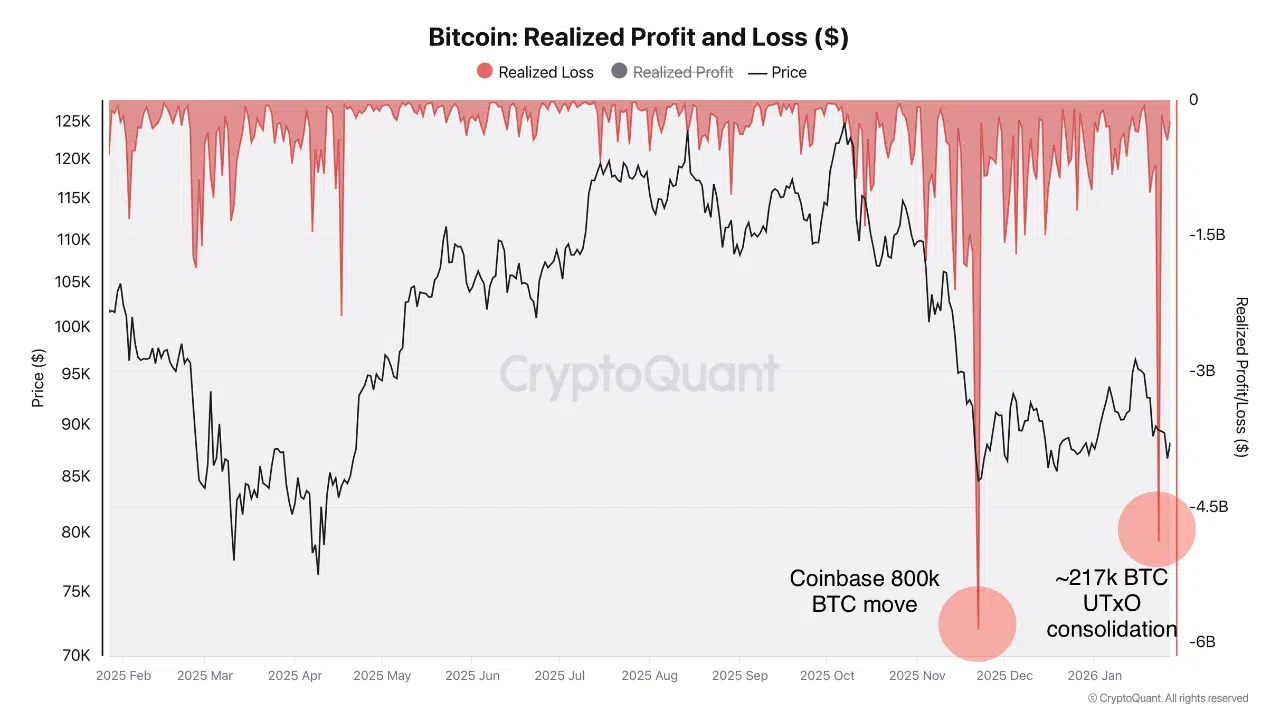
At first glance, this suggested aggressive STH selling. Historically, such spikes often coincide with emotional exits and trend exhaustion. However, price did not follow through to the downside, nor did volatility expand meaningfully, creating an early inconsistency between price behavior and on-chain stress signals.

This divergence prompted a deeper inspection of the underlying UTXO activity.

UTXO Consolidation Triggered a False STH Signal

On January 23, a single block (933,503) included multiple UTXO consolidation transactions that collectively moved approximately 217,000 BTC.

Importantly, these coins were not sold. They were transferred from an address back to the same address, purely to aggregate fragmented UTXOs.

The breakdown of the moved supply shows:

  • ~188,000 BTC from the 3m–6m age band
  • ~30,900 BTC from the 1m–3m band
  • ~31,700 BTC from the 1w–1m band

All BTC in the 3m–6m cohort were likely acquired during the October 10 drawdown, at prices between $102,000 and $126,000. When these UTXOs were destroyed and recreated through consolidation, they were recorded as realized losses because Bitcoin was trading significantly lower on January 23.

This mechanically inflated realized loss metrics without reflecting actual selling pressure.

Why Multiple Indicators Were Distorted

Because realized price is embedded across several on-chain metrics, this consolidation event impacted:

  • STH MVRV
  • STH SOPR
  • Short-term cost basis
  • Aggregate realized loss readings

The effect mirrors a similar false signal observed during the Coinbase-related movement in late November, where internal wallet restructuring briefly produced outsized realized losses without corresponding market exits.

Once these extraordinary events are excluded, the data shows very little genuine on-chain activity, reinforcing the view that neither panic nor aggressive distribution is currently underway.

OKX Launches Stablecoin Card in Europe as MiCA Takes Effect

Market Interpretation and Risk Context

This episode highlights an important limitation of surface-level on-chain analysis. Not all realized losses represent selling, and not all STH signals reflect behavioral stress. In this case, the market absorbed a large technical adjustment without price breakdown, suggesting resilience rather than weakness.

With Bitcoin holding above $85,000 and realized loss pressure largely attributable to accounting mechanics, the broader structure remains one of low participation and consolidation, not capitulation.

Until genuine spending activity increases across multiple age bands, realized loss spikes should be treated cautiously, especially when price action fails to confirm the signal.

Conclusion

The January 23 realized loss spike was not a sell-off, but a UTXO consolidation event that temporarily distorted short-term holder metrics. Once adjusted for this anomaly, on-chain data points to a market with minimal activity and reduced directional conviction.

For now, Bitcoin remains in a holding pattern. Confirmation will require either sustained distribution accompanied by price acceptance below support, or renewed demand that expands both volume and realized profits. Until then, the market appears structurally quiet rather than stressed.

The post Bitcoin Realized Loss Spike Proves False as Market Activity Remains Thin appeared first on ETHNews.

Disclaimer: The articles reposted on this site are sourced from public platforms and are provided for informational purposes only. They do not necessarily reflect the views of MEXC. All rights remain with the original authors. If you believe any content infringes on third-party rights, please contact crypto.news@mexc.com for removal. MEXC makes no guarantees regarding the accuracy, completeness, or timeliness of the content and is not responsible for any actions taken based on the information provided. The content does not constitute financial, legal, or other professional advice, nor should it be considered a recommendation or endorsement by MEXC.

You May Also Like

Royal Government of Bhutan Moves 973 BTC in Latest Treasury Activity

Royal Government of Bhutan Moves 973 BTC in Latest Treasury Activity

The post Royal Government of Bhutan Moves 973 BTC in Latest Treasury Activity appeared on BitcoinEthereumNews.com. The Royal Government of Bhutan transferred 973
Share
BitcoinEthereumNews2026/03/18 19:29
Bubblemaps: The top five traders in STBL token trading volume are interconnected and have made profits exceeding $10 million


Bubblemaps: The top five traders in STBL token trading volume are interconnected and have made profits exceeding $10 million

PANews reported on September 18th that blockchain analytics platform Bubblemaps published an article on the X platform claiming that Tether co-founder Reeve Collins had just launched a new token, STBL. However, the top five traders are suspiciously interconnected and have profited over $10 million. Collins launched STBL yesterday, a new stablecoin system built around three tokens: USST (stablecoin), YLD (yield token supporting USST), and STBL (governance token). An analysis of the top five traders by STBL trading volume revealed that these five profit-makers received capital injections at the same time. Tracing the source of their funds revealed a clear connection: the funds all came from the same source (injected via Tornado Cash); bots were used to borrow USDC from the Venus Protocol; and the total profit exceeded $10 million. However, there is no evidence that these traders are connected to the core team. In fact, this group of bots has a history of extracting value from other tokens, not just STBL.
Share
PANews2025/09/18 10:09
Coinbase Vs. State Regulators: Crypto Exchange Fights Legal Fragmentation

Coinbase Vs. State Regulators: Crypto Exchange Fights Legal Fragmentation

US-based crypto exchange Coinbase has made a significant appeal to the Department of Justice (DOJ) regarding a wave of lawsuits aimed at its operations. The company is urging federal action to address what it describes as an “increasingly fragmented and hostile” regulatory landscape for the crypto market. Coinbase Urges Federal Action  In a recent letter, Coinbase highlighted the steps taken by the current Administration to create a more equitable framework for digital asset regulation. This includes the introduction of stablecoin legislation and two pending bipartisan market-structure bills aimed at fostering uniformity in the oversight of cryptocurrencies.  Coinbase argues that these initiatives have begun to mitigate the adverse effects of the previous Administration’s enforcement-driven regulatory approach.  However, the company warns that certain states are perpetuating this problematic trend by adopting “expansive and flawed” interpretations of securities laws and implementing new licensing requirements that undermine the federal government’s pro-innovation stance. Related Reading: REX Shares Claims Its DOGE And XRP Spot ETFs Will Be Approved By US SEC Tomorrow They make an example with the Oregon Attorney General, who has filed a lawsuit against Coinbase, claiming that many digital assets traded on its platform qualify as alleged unregistered securities.  The letter affirms that the suit not only targets Coinbase but also encourages other states to address what the Attorney General perceives as a regulatory gap left by federal authorities.  Similarly, the New York Attorney General has initiated legal action to regulate transactions involving digital assets based on decentralized protocols as securities, further complicating the regulatory environment. Coinbase has faced cease-and-desist orders from four states, which demand the company halt its retail staking services. These orders are deemed by Coinbase as “legally unfounded and inconsistent.” Unified Framework For Digital Assets In light of these challenges, the letter to the DOJ calls for urgent federal intervention to establish broad preemption provisions. The crypto exchange argues that preemption has historically been an effective tool for addressing state interference in national markets, referencing past Congressional actions. Coinbase contends that the current patchwork of state regulations not only disrupts market efficiency but also leads to unequal access to cryptocurrency services based on geographic location. Related Reading: Citi’s Ethereum Forecast: No New All-Time High Expected, Year-End Target At $4,300 To remedy these issues, Coinbase advocates for Congress to adopt legislation that would exempt federally regulated digital assets from state blue-sky laws and clarify that state licensing requirements do not apply to crypto intermediaries.  Additionally, the company urges the SEC to expedite rulemaking and provide clearer guidance on why digital asset transactions and services, including staking, should not be classified as securities. Such clarity would help prevent states from imposing conflicting regulations based on their interpretations of securities laws. Featured image from Shutterstock, chart from TradingView.com
Share
NewsBTC2025/09/18 15:00