

QFEX Review: Best Perpetual Futures Exchange?
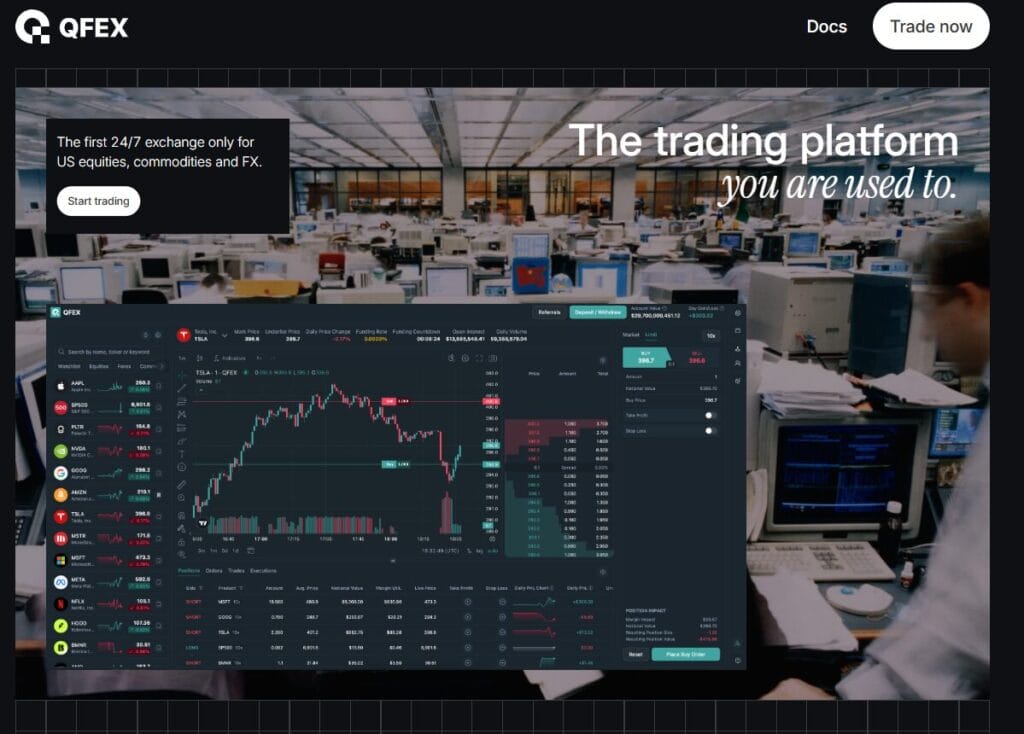
This QFEX Review takes a close look at the first hybrid perpetual futures exchange built around traditional financial assets like equities, commodities, indices, and FX. With 24/7 markets, microsecond-level latency, and CLOB architecture borrowed from top-tier crypto venues, QFEX is positioning itself to take on the $100bn TradFi exchange industry. Here is what makes it stand out.
What is QFEX?
QFEX is the first hybrid perpetual futures exchange that allows high leverage, performant trading on traditional financial assets. Unlike legacy futures venues built around expiries and limited trading hours, QFEX runs continuously, with external market makers providing liquidity outside of regular market hours. It combines the structure of a traditional regulated exchange with the always-on accessibility of a crypto venue.
The platform uses a Centralized Limit Order Book (CLOB) and retains many of the features modern traders expect from crypto exchanges: microsecond-level latency, native fiat and crypto payment rails, anti-HFT arbitrage protections, and built-in circuit breakers. The long-term ambition is to replace the entire traditional exchange, clearing, and brokerage stack — a roughly $100bn industry — and become the trading exchange of choice for global banks, hedge funds, and family offices that want 24/7 access to a wide range of assets, both traditional and complex.
The exchange code is written primarily in Rust and runs on Amazon Web Services hosted in Tokyo, with equal access for all clients via both GUI and API (websockets). Orders execute under strict price-time priority, ensuring transparent and fair matching across all participants.
 QFEX Review
QFEX Review: Features and Products
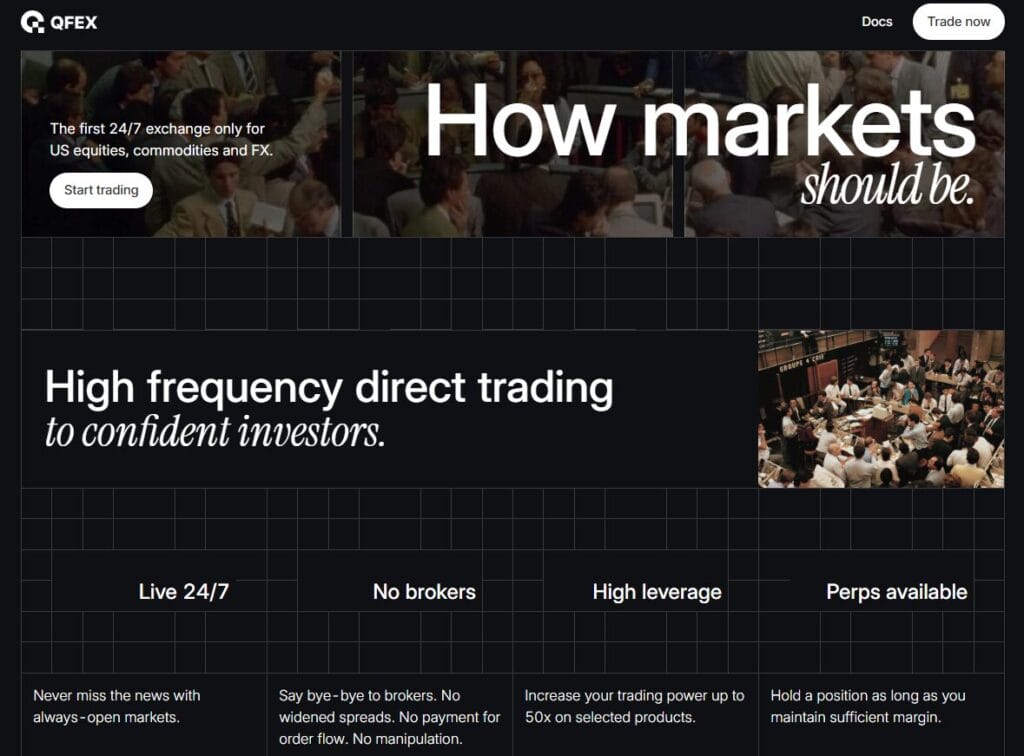
- USDC-margined perpetual futures on traditional financial assets like equities, indices, commodities, and FX, with no expiries and funding computed and paid every single hour instead of every 8 hours
- 15+ US equity perpetuals spanning megacap tech, semiconductors, and high-beta names including NVDA, TSLA, PLTR, AMD, AMZN, META, AAPL, MSFT, HOOD, GOOG, NFLX, MSTR, BMNR, CRWV, and RKLB
- US index perpetuals covering US 500 and US 100, allowing leveraged 24/7 exposure to broad American equity benchmarks even when the underlying cash markets in New York are closed for the day
- Commodity perpetuals on Gold, Silver, and Uranium, giving traders continuous access to precious metal and macro-driven exposure outside the trading hours of traditional commodity exchanges and futures venues
- FX perpetuals on the most liquid major pairs including GBP/USD, EUR/USD, and AUD/USD, all margined in USDC and tradable around the clock without the spread games typical of retail FX brokers
- 24/7 continuous trading supported by external market makers providing liquidity even when the underlying cash market is closed, so equities, indices, FX, and commodities can be traded every hour, every day
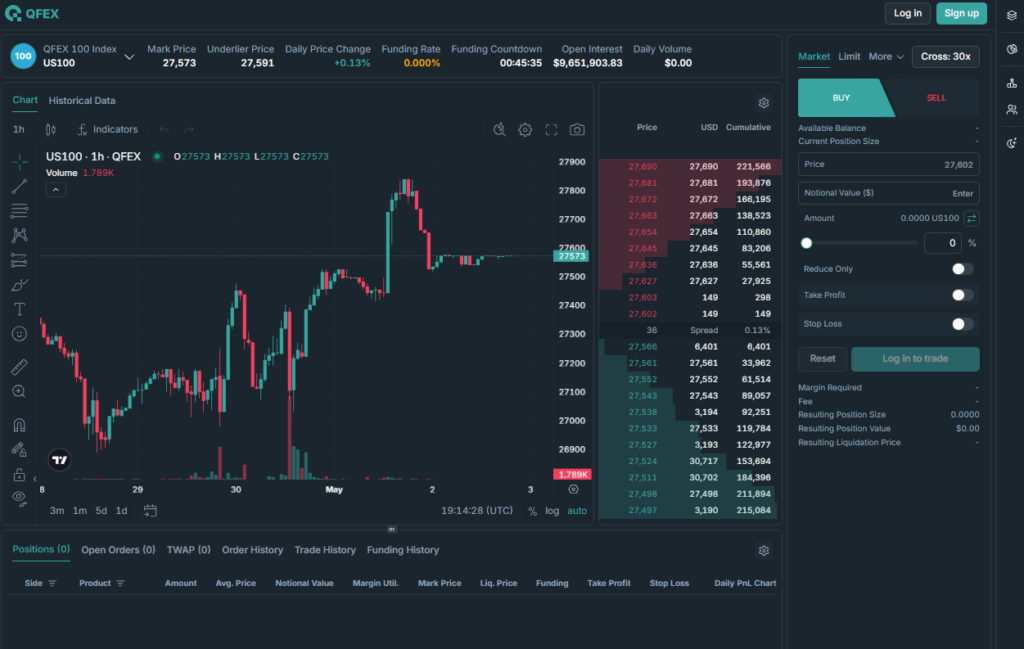
- Centralized Limit Order Book with strict price-time priority that aggregates all buy and sell orders into a single transparent book, displaying the best available prices and quantities to every participant simultaneously
- Microsecond-level matching engine written primarily in Rust and deployed on Amazon Web Services in Tokyo, providing equal access on the same terms to every client connecting via either the GUI or websocket API
- 100-millisecond speed bump on all limit orders that neutralizes latency arbitrage and creates a level playing field for every participant, regardless of technological sophistication or network connectivity, in line with standard industry practice
- Self-trade prevention that automatically cancels the passive order whenever two orders from the same trader match, eliminating wash-trade risk and ensuring all activity reported on the venue reflects genuine market interest
- Subaccounts that let users segregate trading strategies, ringfence margin and risk across different books, and run multiple discretionary or systematic approaches under a single onboarded master account without cross-strategy contamination
- Native fiat and crypto payment rails including bank transfer support for deposits and withdrawals, removing the friction of routing capital through third-party brokers and letting traders move funds directly between their accounts and QFEX
- TradingView-powered charting offering advanced charts, multiple drawing tools, dozens of technical indicators, and a built-in stock screener — the same professional toolkit traders are already familiar with from other major venues
- Five-tier maker-taker fee structure based on Effective Volume that weights different asset classes — FX counted at 1x, commodities and indices at 2x, and single stocks at 5x — with Tier 1 makers paying zero
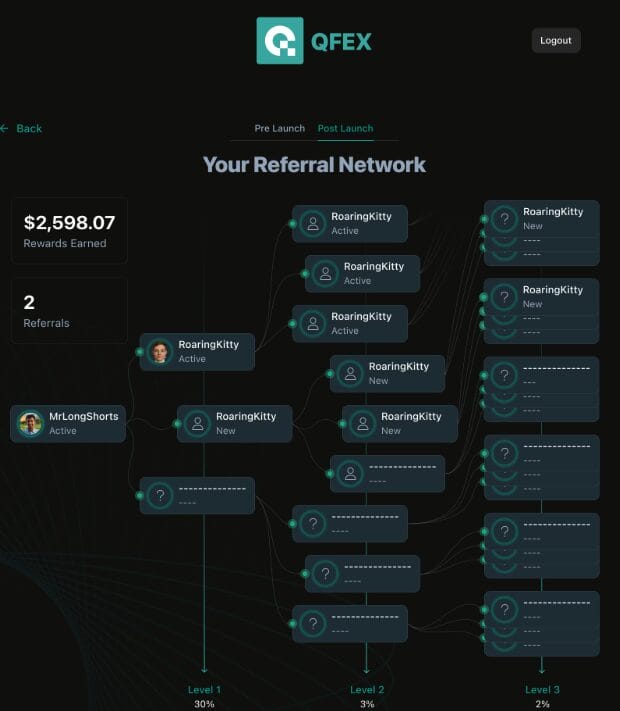
- Three-tier referral program with uncapped commissions paying 30%, 3%, and 2% across direct, indirect, and extended referrals, plus an automatic 10% trading-fee discount for everyone who signs up using a referral link
 QFEX Review
QFEX Review: Pricing
QFEX uses a maker-taker fee model with five tiers, calculated on a 30-day rolling Effective Volume that weights asset classes differently — FX counts 1x, commodities and indices 2x, and single stocks 5x. Tier 1 makers trade for free across every product.
Partially-matched orders pay taker fees on the filled portion and maker fees on whatever rests on the book afterward. Referred users automatically receive a 10% discount on top of their tier-based fee.
QFEX Review: Mobile App
QFEX is delivered as a unified web platform accessible from any modern browser, meaning traders can connect from desktop or mobile without installing additional software. Both market data and order entry are available through GUI and API channels with equal access terms for every client. The same speed-bump rules, self-trade prevention, and tick-size regime apply uniformly regardless of how the trader connects, ensuring that retail users on mobile face the same fair-market conditions as institutions running co-located algorithms. With TradingView powering the charts, mobile users get the same advanced charting experience as desktop traders.
QFEX Review: Security
QFEX takes a layered approach to platform security and market integrity:
- Mandatory KYC — every user is verified before being allowed to trade. The team chose this route after weighing safety and liquidity tradeoffs, since KYC blocks most of the attack vectors that no-KYC exchanges face by limiting bad actors’ ability to spin up new accounts.
- Geographic restrictions — onboarding is blocked from sanctioned and certain regulated jurisdictions, including the United States, United Kingdom, France, Spain, Ukraine, Syria, Iran, Russia, North Korea, Myanmar, Belarus, Venezuela, and Sudan.
- 100ms speed bump on all limit orders neutralizes latency arbitrage and creates a level playing field for retail and institutional flows alike.
- Self-trade prevention automatically cancels passive orders when both sides come from the same account, removing wash-trade risk.
- Circuit breakers and price bands — QFEX follows the futures paradigm of price limits at a fixed width around the last known underlier price, allowing trading to continue safely during volatility events on the underlying spot market.
- Tick-size regime is reviewed and recalibrated weekly to keep markets orderly.
- Subaccount segregation allows users to ringfence strategies and limit cross-strategy risk contamination.
QFEX Review: UI and UX
The interface is built around a single transparent order book that surfaces the best bids and offers to every market participant simultaneously. Charting is powered by TradingView, giving users access to advanced technical analysis tools, indicators, and a built-in stock screener directly within the platform. Equal-terms GUI and API access means a discretionary trader looking at a chart and a quant firm pushing orders over websockets are using the same underlying matching infrastructure. The decision to ban self-trades, cap latency advantages with the speed bump, and publish detailed contract specifications all add up to a UX that prioritizes trust and clarity over shiny add-ons. Funding accruals every hour also give traders more frequent, smaller payments rather than larger 8-hour swings.
QFEX Review: Referral and Affiliate
QFEX runs a three-tier referral program designed to reward community building with passive income that scales as referred users trade more. Each user receives a unique referral link at qfex.com/@username that can be shared anywhere. People who sign up through a referral link automatically get a 10% discount on trading fees, and commissions are uncapped across all three levels.
For example, if a Level 1 referral trades $100,000 with QFEX charging 0.1%, the referrer earns $30 from that single day’s activity. Commissions are calculated on QFEX’s net fee after user discounts and promotions, so payouts always reflect what was actually collected. Onboarding must be completed for referral payouts to be eligible.
 QFEX Review
QFEX Review: Conclusion
QFEX takes a genuinely ambitious shot at one of the largest unmodernized corners of finance: the traditional exchange, clearing, and brokerage stack. By marrying a CLOB-based matching engine with crypto-style features like 24/7 markets, USDC-margined perpetuals, hourly funding, and a referral program, the team is bridging two worlds that have historically operated separately.
The fee schedule is competitive — particularly Tier 1 makers trading for free — and the platform’s architectural decisions, from the 100ms speed bump to mandatory KYC, signal a serious commitment to fairness and market integrity. Founded by ex-Flow Traders, ex-Citadel, and ex-Tower Research talent and backed by General Catalyst and Y Combinator, QFEX has the resources and pedigree to potentially redefine how leveraged exposure to equities, indices, commodities, and FX is traded.
Does QFEX require KYC?
Yes. All users must complete KYC before trading. The team chose this to block attack vectors common on no-KYC venues and to enable institutional liquidity providers to participate.
Where is QFEX not available?
Onboarding is currently restricted in the United States, United Kingdom, France, Spain, Ukraine, Syria, Iran, Russia, North Korea, Myanmar, Belarus, Venezuela, and Sudan, among others.
What charting does QFEX use?
Charting is powered by TradingView, including advanced charts and a built-in stock screener.


You May Also Like

Tillis Accelerates Stablecoin Bill: BTC Effect
XRP Price Primed for $2 Breakout as Top Analyst Names Key Levels to Watch




