TLDR Gold dropped below $5,000 an ounce, extending two straight weeks of losses Rising oil prices above $100 a barrel are pushing inflation fears higher The US-TLDR Gold dropped below $5,000 an ounce, extending two straight weeks of losses Rising oil prices above $100 a barrel are pushing inflation fears higher The US-

Gold Falls Below $5,000 as Middle East War Fuels Oil Surge and Rate Cut Fears

2026/03/16 20:06
3 min read
For feedback or concerns regarding this content, please contact us at crypto.news@mexc.com

TLDR

  • Gold dropped below $5,000 an ounce, extending two straight weeks of losses
  • Rising oil prices above $100 a barrel are pushing inflation fears higher
  • The US-Israel conflict with Iran has entered its third week with no end in sight
  • The Federal Reserve is widely expected to hold rates steady this week
  • Gold is still up more than 15% in 2026 despite recent weakness

The US military struck Iran’s Kharg Island oil terminal last weekend. That attack — and Iran’s retaliatory strikes on Israel and energy infrastructure in the Gulf — pushed crude oil above $100 a barrel.

Gold fell 0.6% to around $4,987 an ounce in early London trading on Monday. That puts the metal below the key $5,000 mark for the first time in recent sessions.
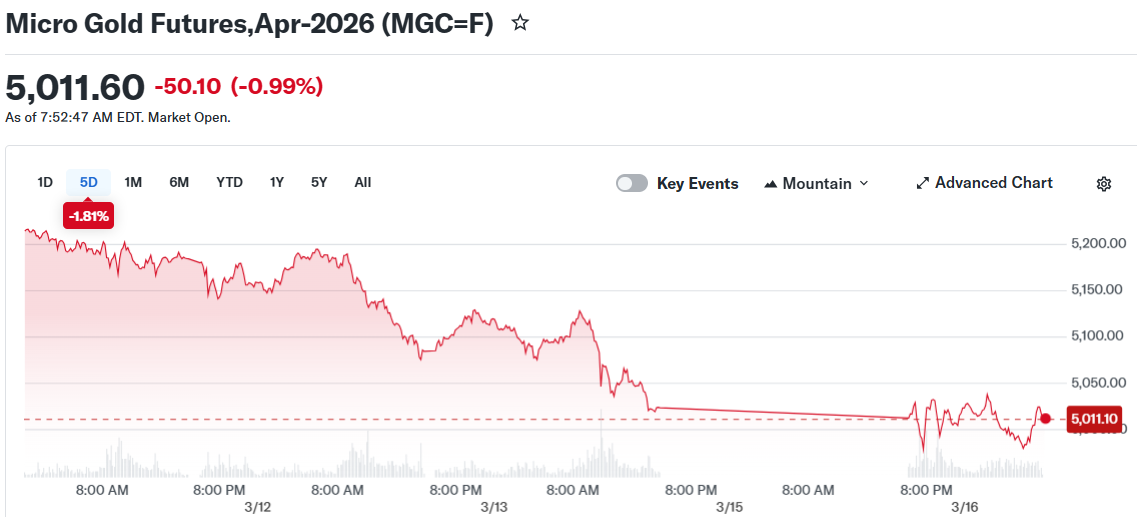
Micro Gold Futures,Apr-2026 (MGC=F)Micro Gold Futures,Apr-2026 (MGC=F)

The conflict is now in its third week. An aide to President Donald Trump said the war could last four to six weeks, though both sides have given mixed signals about a potential deal.

Iran struck shipping lanes near the Strait of Hormuz over the weekend. That waterway carries roughly one-fifth of the world’s oil and liquefied natural gas, and shipping there has nearly come to a standstill.

Oil prices fluctuated above $100 a barrel on Monday. Higher energy costs are feeding inflation concerns and making the Fed less likely to cut interest rates in the near term.

When rates stay high, gold becomes less attractive. The metal pays no interest, so rising borrowing costs tend to push investors toward yield-bearing assets instead.

Why Gold Is Under Pressure

Traders now see virtually no chance of a rate cut at this week’s Fed meeting. That expectation is one of the main weights on the gold price right now.

US consumer spending data released last Friday showed spending barely grew in January. Consumer sentiment has also dropped to a three-month low, as worries about gasoline prices mount.

Gold has still gained more than 15% so far in 2026. But upward momentum has stalled as the market waits to see how the conflict develops and whether the Fed signals any change in direction.

Silver fell 2.2% to $78.79 an ounce. Palladium was steady. Platinum edged higher. The Bloomberg Dollar Index slipped 0.2% after gaining more than 1% the prior week.

UBS Global Wealth Management said in a note Monday that gold acts more as a hedge against broader economic risks than direct war threats. The bank said gold protects against currency devaluation, rising deficits, and economic slowdowns — all possible outcomes of a prolonged conflict.

What the Charts Are Saying

Technical analysis points to further short-term weakness. Gold broke below the $5,035 support level on Monday and analysts are watching the $4,953 level as the next key target.

The MACD indicator is below the centreline and pointing lower. The Stochastic oscillator also supports a bearish short-term view.

A corrective bounce toward $5,200 is possible if any central bank meeting this week delivers a dovish surprise, according to technical forecasts. Beyond that, bulls would need to retake $5,412 to signal a resumption of the longer-term uptrend.

The Fed decision is due this week along with rate announcements from central banks in the Eurozone, UK, Japan, Switzerland, Australia, Canada, China, Brazil, and Russia.

The post Gold Falls Below $5,000 as Middle East War Fuels Oil Surge and Rate Cut Fears appeared first on CoinCentral.

Market Opportunity
SURGE Logo
SURGE Price(SURGE)
$0.01898
$0.01898$0.01898
-0.99%
USD
SURGE (SURGE) Live Price Chart
Disclaimer: The articles reposted on this site are sourced from public platforms and are provided for informational purposes only. They do not necessarily reflect the views of MEXC. All rights remain with the original authors. If you believe any content infringes on third-party rights, please contact crypto.news@mexc.com for removal. MEXC makes no guarantees regarding the accuracy, completeness, or timeliness of the content and is not responsible for any actions taken based on the information provided. The content does not constitute financial, legal, or other professional advice, nor should it be considered a recommendation or endorsement by MEXC.

You May Also Like

And the Big Day Has Arrived: The Anticipated News for XRP and Dogecoin Tomorrow

And the Big Day Has Arrived: The Anticipated News for XRP and Dogecoin Tomorrow

The first-ever ETFs for XRP and Dogecoin are expected to launch in the US tomorrow. Here's what you need to know. Continue Reading: And the Big Day Has Arrived: The Anticipated News for XRP and Dogecoin Tomorrow
Share
Coinstats2025/09/18 04:33
Swiss Franc Intervention: Critical Analysis of SNB’s 2025 Policy and Safe-Haven Resilience

Swiss Franc Intervention: Critical Analysis of SNB’s 2025 Policy and Safe-Haven Resilience

BitcoinWorld Swiss Franc Intervention: Critical Analysis of SNB’s 2025 Policy and Safe-Haven Resilience ZURICH, March 2025 – The Swiss National Bank faces mounting
Share
bitcoinworld2026/03/16 23:10
Cashing In On University Patents Means Giving Up On Our Innovation Future

Cashing In On University Patents Means Giving Up On Our Innovation Future

The post Cashing In On University Patents Means Giving Up On Our Innovation Future appeared on BitcoinEthereumNews.com. “It’s a raid on American innovation that would deliver pennies to the Treasury while kneecapping the very engine of our economic and medical progress,” writes Pipes. Getty Images Washington is addicted to taxing success. Now, Commerce Secretary Howard Lutnick is floating a plan to skim half the patent earnings from inventions developed at universities with federal funding. It’s being sold as a way to shore up programs like Social Security. In reality, it’s a raid on American innovation that would deliver pennies to the Treasury while kneecapping the very engine of our economic and medical progress. Yes, taxpayer dollars support early-stage research. But the real payoff comes later—in the jobs created, cures discovered, and industries launched when universities and private industry turn those discoveries into real products. By comparison, the sums at stake in patent licensing are trivial. Universities collectively earn only about $3.6 billion annually in patent income—less than the federal government spends on Social Security in a single day. Even confiscating half would barely register against a $6 trillion federal budget. And yet the damage from such a policy would be anything but trivial. The true return on taxpayer investment isn’t in licensing checks sent to Washington, but in the downstream economic activity that federally supported research unleashes. Thanks to the bipartisan Bayh-Dole Act of 1980, universities and private industry have powerful incentives to translate early-stage discoveries into real-world products. Before Bayh-Dole, the government hoarded patents from federally funded research, and fewer than 5% were ever licensed. Once universities could own and license their own inventions, innovation exploded. The result has been one of the best returns on investment in government history. Since 1996, university research has added nearly $2 trillion to U.S. industrial output, supported 6.5 million jobs, and launched more than 19,000 startups. Those companies pay…
Share
BitcoinEthereumNews2025/09/18 03:26