

What is the top 10 coin?
The goal is to help everyday readers approach top 10 lists with the right questions so they can use those lists as research starting points rather than as recommendations.
What “coin in market” means: a clear definition and quick context
When people ask about a coin in market they most often mean a cryptocurrency listed among the top 10 by market capitalization. Market capitalization is calculated as circulating supply multiplied by price, and most public top 10 lists use that formula as a starting point for ranking tokens CoinMarketCap explanation.
This ranking is a snapshot. Prices and circulating supply update constantly, so a top 10 entry can move up or down as market conditions change. Use the live lists as a starting point for research rather than a recommendation. (See our Bitcoin price analysis for an example of how price moves can affect rank.)
Check the reported circulating supply and market-cap calculation, then verify 24h volume and liquidity scores, examine exchange listings and order book depth, and review project documentation and developer activity to confirm real-world use.
Major data aggregators publish live top 10 coins lists that apply the market-cap calculation and then surface additional indicators like volume or liquidity on the same page. You will see similar lists across providers and they are meant to help you find which coins draw the most market attention CoinMarketCap live list.
As you read on, keep in mind that top 10 is a convenient label. It points you to large or widely quoted coins, but it does not replace direct verification of supply, liquidity, and adoption metrics.

How market capitalization is calculated for a coin in market
The basic market-cap formula is simple: market cap equals circulating supply multiplied by the current price. Circulating supply is the number of coins that are available and circulating in public hands, not necessarily the total issued supply Investopedia overview.
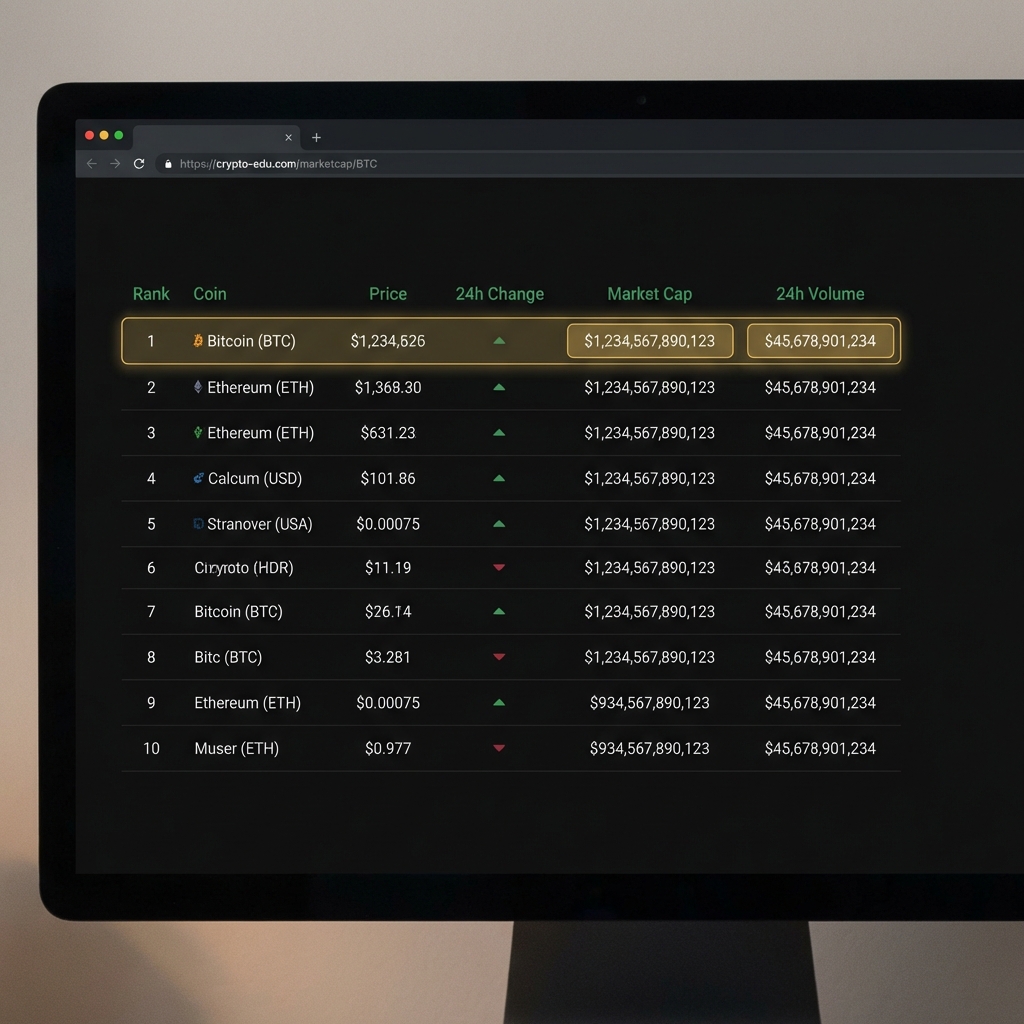
Circulating supply can be defined differently by each data provider. Some aggregators exclude locked or vested tokens, while others adjust supply with onchain rules or project disclosures. Those differences change the market-cap result and can affect whether a given coin shows up in a top 10 list.
When you see market-cap numbers on aggregator pages, look for methodology notes that describe which supply items are included or excluded. That helps you understand whether the number reflects freely tradable coins or a broader accounting of total units.
Why a raw top-10 list can be misleading for one “coin in market”
A raw top-10 list based solely on market cap can be misleading when a coin has low circulating float or thin trading activity. A high price multiplied by a small number of circulating units can produce a large market-cap figure even if there is little liquidity to buy or sell at that valuation CoinMarketCap explanation. (LiquidityFinder offers a model for assessing situations where market cap and liquidity diverge LiquidityFinder.)
Another common issue is that market-cap snapshots do not show whether trades can be executed without moving the price. That is where liquidity and volume indicators come in: they help distinguish coins that are theoretically large on paper from those that are actively traded and transferable without extreme slippage.
A short checklist to quickly inspect supply and liquidity
Use aggregator methodology pages first
In practical terms, treat the market-cap number as a starting signal. If you want to assess tradeability or research a coin further, check exchange order books, volume history, and methodology pages that explain how supply was counted.
Liquidity and volume: how aggregators flag thin trading for a coin in market
Liquidity describes how easily an asset can be bought or sold at stable prices. 24-hour trading volume is a common proxy for recent liquidity and helps confirm that market-cap size is backed by trading activity CoinGecko methodology.
Many aggregators compute liquidity scores or apply volume thresholds to flag coins that trade thinly. These indicators are shown beside market-cap figures to help readers identify entries that may be large on paper but lack trade depth. See Kaiko’s token liquidity ranking for one example of a liquidity-based approach Kaiko research.
When you review a top 10 coin entry on an aggregator, check the listed 24h volume and the exchanges where the coin is quoted. Multiple active exchange listings and sustained volume tend to make rank comparisons more reliable than a market-cap number on its own. (See our coverage of exchange listings for context exchange listing example.)
Adoption signals beyond market cap for a coin in market
Adoption indicators offer qualitative context that market cap cannot. Common metrics include onchain activity, developer contribution levels, merchant acceptance, and user adoption indices that measure regional or sector uptake Chainalysis adoption index.
These signals are increasingly used by analysts to qualify whether a top 10 coin has real-world usage or only speculative interest. That said, there is not yet a single standardized adoption metric across providers, so adoption measures are best treated as complementary evidence.
Why ranking lists differ: methodological choices across aggregators
Different data providers can produce different top 10 lists because they apply different rules for supply, which exchanges they include, and how they filter for liquidity. These methodological choices affect which coins appear in the top ranks and in what order CoinGecko methodology. CoinRanking also explains its ranking approach and filters in its help documentation CoinRanking methodology.
For example, one provider might remove certain locked supplies from circulating totals, while another treats them as part of supply. Another provider might exclude small or unverified exchanges when calculating volume. Those choices can move a coin up or down relative to peers.
To reconcile differences, check the methodology pages on aggregator sites and confirm the coin’s supply disclosures on project pages. Cross-checking helps you understand whether a ranking gap is due to true market differences or just different calculation rules.
A practical checklist to verify a top-10 coin in market
Below is a step-by-step checklist you can use when evaluating any coin that appears in a top 10 list. Work through the items before drawing conclusions about how tradeable or adopted a coin is.
- Confirm the market-cap calculation and which circulating supply the aggregator used.
- Check 24h volume and liquidity scores to see if the coin trades actively on multiple exchanges.
- Look at exchange listings and whether major venues show consistent order book depth.
- Read the project whitepaper and the project documentation linked from official sources.
- Review developer activity on public repositories and look for independent adoption indices.
- Cross-check at least two aggregators to reconcile methodology differences.
Advertise with FinancePolice to reach readers researching markets
Use this checklist to guide further reading on FinancePolice and to confirm entries before treating a top 10 coin as part of your research.
See advertising options
Following these steps helps you move from a single market-cap snapshot to a rounded view that includes tradeability and real-world use.
Common mistakes readers make when using a top-10 list
A frequent error is treating a top-10 ranking as an endorsement. A high rank shows market attention, not a recommendation or evidence of safety. Always apply independent checks before forming conclusions about a coin.
Another misstep is ignoring liquidity and adoption. Relying on market cap alone can hide thin float or concentrated holdings that make trading risky. Check volume, exchange coverage, and developer activity to reduce this risk.
Finally, some readers focus too much on short-term rank moves. Daily or hourly rank shifts often reflect transient price swings or volume spikes. Look for sustained changes in volume and onchain indicators to decide whether a move is significant.
Examples and scenarios: how the same “coin in market” can appear differently
Imagine a coin whose project team reclassifies a portion of tokens from locked status to circulating supply. That change alone can increase the reported circulating supply and alter the market-cap calculation, shifting the coin lower in a top 10 list even if price and liquidity stay constant CoinMarketCap explanation.
Conversely, a major exchange listing can suddenly increase liquidity and 24h volume. When that happens, a coin that previously traded thinly may become more tradeable and maintain a higher rank for longer. Watching exchange listings alongside volume helps identify which scenario is occurring.
How often top-10 coin lists change and what that means for readers
Aggregator lists refresh in near real time to reflect price and supply updates. That means the top 10 can show short-term volatility as markets move. Real-time updates are useful for a live snapshot, but they also capture noise that is not always meaningful.
To decide whether a rank change matters, look for sustained volume increases or persistent changes in onchain activity and developer metrics. A one-day volume spike tends to be less informative than a multiweek trend in adoption indicators CoinMarketCap live list.
Tools and sources to track a coin in market
Start with reputable aggregator pages that show live market-cap ranks and methodology notes. These pages are where you will find the market-cap number, circulating supply details, and often liquidity or volume indicators CoinMarketCap live list. For related coverage on this site see our crypto category.
Complement aggregator data with primary project sources: the project whitepaper, the official website and documentation, and public developer repositories. These primary sources are essential when you need to verify supply statements or technical claims.
A short decision framework: when to treat a top-10 coin as credible research
Use market cap as an initial signal, then test tradeability with liquidity and 24h volume. If those indicators are strong, add adoption signals such as onchain usage and developer activity to form a fuller view Chainalysis adoption index.
For everyday readers, ask whether the coin matches your time horizon and risk tolerance. If you do not have time to do cross-checks, treat the top 10 list as a pointer to further reading rather than as a basis for action.
Closing: how to use the top-10 coin list as a starting point
Top-10 commonly means market-cap ranking, but that number alone can miss liquidity and adoption context. Use the checklist and tools described above to verify supply definitions, volume, exchange listings, and adoption indicators before drawing stronger conclusions.
As a final step, cross-check multiple aggregators and consult primary project documentation. Treat list entries as informational starting points and not as investment advice.
It typically refers to a cryptocurrency listed among the top 10 by market capitalization, calculated as circulating supply times price.
Lists differ because aggregators use different rules for circulating supply, exchange coverage, and liquidity filters which change the ranking outcomes.
Start by confirming the circulating supply and market-cap calculation, then check 24h volume, liquidity indicators, exchange listings, and project documentation.
References
- https://coinmarketcap.com/alexandria/article/how-market-cap-is-calculated
- https://coinmarketcap.com/
- https://www.investopedia.com/how-market-cap-cryptocurrency-5183924
- https://liquidityfinder.com/insight/crypto/a-new-modelfor-assessing-crypto-asset-liquidity
- https://research.kaiko.com/insights/q4-2023-liquidity-ranking
- https://www.coingecko.com/en/methodology
- https://financepolice.com/advertise/
- https://go.chainalysis.com/2024-global-crypto-adoption-index.html
- https://support.coinranking.com/article/56-how-do-we-rank-coins
- https://financepolice.com/bitcoin-price-analysis-btc-reclaims-92000-as-market-awaits-fed-decision/
- https://financepolice.com/coinhub-exchange-brings-a-bank-like-crypto-experience-to-las-vegas-and-phoenix/
- https://financepolice.com/category/crypto/
You May Also Like

Spot silver falls below the $100 mark

Solana network saw its active addresses more than double to over 5 million in January, with daily transaction volume jumping to 87 million.