The post LUNC Price Flashes Early Signs of a Macro Bottom—Is a 288% Technical Reversal Possible? appeared first on Coinpedia Fintech News LUNC price has quietlyThe post LUNC Price Flashes Early Signs of a Macro Bottom—Is a 288% Technical Reversal Possible? appeared first on Coinpedia Fintech News LUNC price has quietly

LUNC Price Flashes Early Signs of a Macro Bottom—Is a 288% Technical Reversal Possible?
Why Terra Luna Price Is Up Today

The post LUNC Price Flashes Early Signs of a Macro Bottom—Is a 288% Technical Reversal Possible? appeared first on Coinpedia Fintech News

LUNC price has quietly put together an unexpected bounce over the past week, climbing from around $0.000026 to above $0.00008 — roughly a 150% move that stands out after months of heavy selling. The shift comes as downside pressure finally appears to be easing, with LUNA and USTC also seeing speculative inflows that have revived interest across the Terra ecosystem. 

The fundamentals remain shaky, but the recent price behaviour suggests the market may be stabilising after a long period of exhaustion—and this sets the stage for a deeper look at whether a true higher-timeframe reversal is forming.

Early Bullish Intent and Conditions for MSS Confirmation

LUNC is showing its first signs of bullish displacement, hinting at a possible shift in order flow. However, these signals remain preliminary and require validation. The key trigger is a monthly close above the Market Structure Shift (MSS) level at $0.00007300. A confirmed MSS would establish a higher-timeframe trend reversal, unlock bullish Points of Interest (POIs), and open continuation setups through Breaker Blocks, Order Blocks, or Fair Value Gaps. 

Only after this confirmation can price realistically pull toward buyside liquidity at $0.00017980 and the larger draw at $0.00028000 — a potential 288% expansion.

Technical Analysis: Structure, Levels, and Liquidity Zone

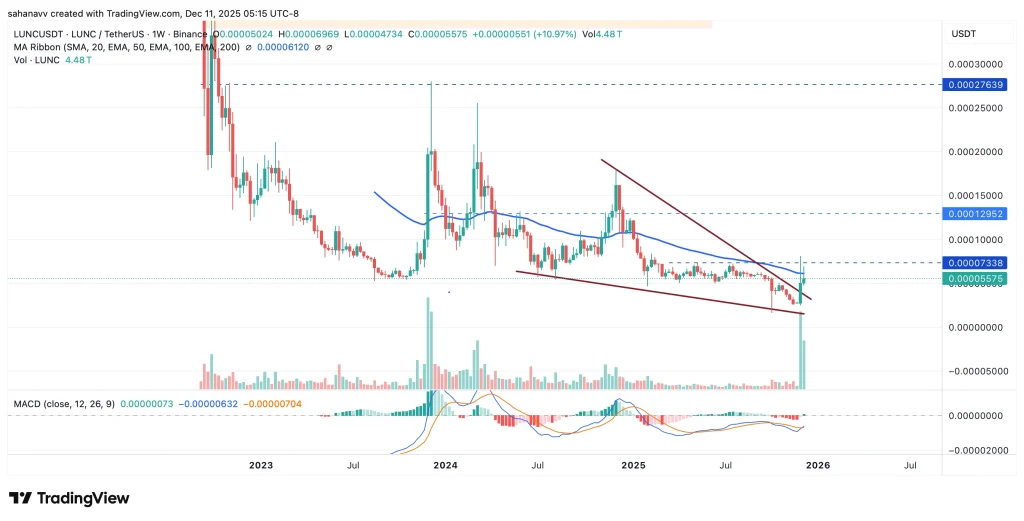
LUNC has broken out of a long-standing falling wedge on the weekly timeframe — its first meaningful structural break in months. The breakout was supported by a sharp surge in volume, indicating genuine market participation rather than a thin liquidity spike. Price has also reclaimed the 50-week moving average, a level it consistently struggled with throughout mid-2024 and 2025, which now acts as short-term support.
lunc price

The next major hurdle sits at $0.00007338, a key HTF level that price has tapped but not closed above. Clearing this zone would shift the weekly market structure and validate the broader reversal narrative. Above that, the next liquidity magnet is the $0.00012952 level, followed by the larger liquidity draw at $0.00027639.

Momentum indicators are improving as well: the MACD is crossing upward from deeply negative territory, suggesting the downtrend may finally be losing strength. While these signals are constructive, the lack of strong fundamentals means any upside continuation relies heavily on sustained volume and confirmation through higher closes.

Conclusion-What’s Next for LUNC Price?

LUNC is displaying its strongest macro-reversal signals in years, but technicals alone cannot override weak fundamentals and inconsistent demand. A monthly close above $0.00007300 is essential to confirm a legitimate Market Structure Shift; without it, any bounce remains vulnerable to rejection and renewed downside. If MSS validates, a controlled move toward liquidity zones at $0.00017980 and $0.00028000 becomes feasible. 

However, failure to reclaim MSS places LUNC at risk of prolonged sideways accumulation or deeper retests of lower support. Traders should view this as a technically promising setup, not a guaranteed reversal.


Market Opportunity
Terra Classic Logo
Terra Classic Price(LUNC)
$0.00003833
$0.00003833$0.00003833
+3.00%
USD
Terra Classic (LUNC) Live Price Chart
Disclaimer: The articles reposted on this site are sourced from public platforms and are provided for informational purposes only. They do not necessarily reflect the views of MEXC. All rights remain with the original authors. If you believe any content infringes on third-party rights, please contact service@support.mexc.com for removal. MEXC makes no guarantees regarding the accuracy, completeness, or timeliness of the content and is not responsible for any actions taken based on the information provided. The content does not constitute financial, legal, or other professional advice, nor should it be considered a recommendation or endorsement by MEXC.

You May Also Like

The Channel Factories We’ve Been Waiting For

The Channel Factories We’ve Been Waiting For

The post The Channel Factories We’ve Been Waiting For appeared on BitcoinEthereumNews.com. Visions of future technology are often prescient about the broad strokes while flubbing the details. The tablets in “2001: A Space Odyssey” do indeed look like iPads, but you never see the astronauts paying for subscriptions or wasting hours on Candy Crush.  Channel factories are one vision that arose early in the history of the Lightning Network to address some challenges that Lightning has faced from the beginning. Despite having grown to become Bitcoin’s most successful layer-2 scaling solution, with instant and low-fee payments, Lightning’s scale is limited by its reliance on payment channels. Although Lightning shifts most transactions off-chain, each payment channel still requires an on-chain transaction to open and (usually) another to close. As adoption grows, pressure on the blockchain grows with it. The need for a more scalable approach to managing channels is clear. Channel factories were supposed to meet this need, but where are they? In 2025, subnetworks are emerging that revive the impetus of channel factories with some new details that vastly increase their potential. They are natively interoperable with Lightning and achieve greater scale by allowing a group of participants to open a shared multisig UTXO and create multiple bilateral channels, which reduces the number of on-chain transactions and improves capital efficiency. Achieving greater scale by reducing complexity, Ark and Spark perform the same function as traditional channel factories with new designs and additional capabilities based on shared UTXOs.  Channel Factories 101 Channel factories have been around since the inception of Lightning. A factory is a multiparty contract where multiple users (not just two, as in a Dryja-Poon channel) cooperatively lock funds in a single multisig UTXO. They can open, close and update channels off-chain without updating the blockchain for each operation. Only when participants leave or the factory dissolves is an on-chain transaction…
Share
BitcoinEthereumNews2025/09/18 00:09
Shanghai residents flock to sell gold as its price hit record highs

Shanghai residents flock to sell gold as its price hit record highs

The post Shanghai residents flock to sell gold as its price hit record highs appeared on BitcoinEthereumNews.com. Gold surged over the $5,500-per-ounce milestone
Share
BitcoinEthereumNews2026/01/31 01:48
Polygon Tops RWA Rankings With $1.1B in Tokenized Assets

Polygon Tops RWA Rankings With $1.1B in Tokenized Assets

The post Polygon Tops RWA Rankings With $1.1B in Tokenized Assets appeared on BitcoinEthereumNews.com. Key Notes A new report from Dune and RWA.xyz highlights Polygon’s role in the growing RWA sector. Polygon PoS currently holds $1.13 billion in RWA Total Value Locked (TVL) across 269 assets. The network holds a 62% market share of tokenized global bonds, driven by European money market funds. The Polygon POL $0.25 24h volatility: 1.4% Market cap: $2.64 B Vol. 24h: $106.17 M network is securing a significant position in the rapidly growing tokenization space, now holding over $1.13 billion in total value locked (TVL) from Real World Assets (RWAs). This development comes as the network continues to evolve, recently deploying its major “Rio” upgrade on the Amoy testnet to enhance future scaling capabilities. This information comes from a new joint report on the state of the RWA market published on Sept. 17 by blockchain analytics firm Dune and data platform RWA.xyz. The focus on RWAs is intensifying across the industry, coinciding with events like the ongoing Real-World Asset Summit in New York. Sandeep Nailwal, CEO of the Polygon Foundation, highlighted the findings via a post on X, noting that the TVL is spread across 269 assets and 2,900 holders on the Polygon PoS chain. The Dune and https://t.co/W6WSFlHoQF report on RWA is out and it shows that RWA is happening on Polygon. Here are a few highlights: – Leading in Global Bonds: Polygon holds 62% share of tokenized global bonds (driven by Spiko’s euro MMF and Cashlink euro issues) – Spiko U.S.… — Sandeep | CEO, Polygon Foundation (※,※) (@sandeepnailwal) September 17, 2025 Key Trends From the 2025 RWA Report The joint publication, titled “RWA REPORT 2025,” offers a comprehensive look into the tokenized asset landscape, which it states has grown 224% since the start of 2024. The report identifies several key trends driving this expansion. According to…
Share
BitcoinEthereumNews2025/09/18 00:40