Yen Falls to 40-Year Low as Dollar Strength Continues – Will Japan Step In Again?
TLDR
- The dollar climbed to 162.41 yen on Tuesday, the weakest level for the yen since 1986.
- Traders are pricing in a higher chance the Federal Reserve will raise rates this year.
- Japan spent 11.7 trillion yen ($72.25 billion) in April and May to support its currency, but the effect faded.
- Finance Minister Satsuki Katayama said Japan stands ready to act but stopped short of strong warning language.
- The euro also weakened against the dollar, trading near $1.1396, close to a one-year low.
The Japanese yen dropped to its weakest level against the dollar in 40 years on Tuesday. The dollar rose as high as 162.41 yen before settling around 162.15.
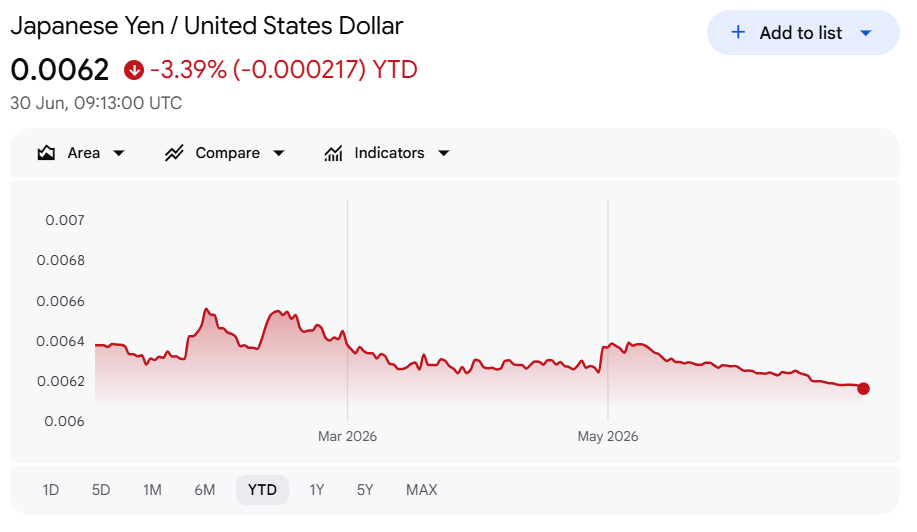 Source: Google Finance
This marks the lowest point for the yen since 1986. The move has raised questions about whether Japan will step in to support its currency again.
Why the Dollar Is Gaining Strength
The main driver behind the yen’s weakness is rising expectations for U.S. interest rates. Inflation in the United States remains above the Federal Reserve’s target.
At this month’s Federal Reserve meeting, nine of nineteen policymakers said they expect a rate hike before the end of the year. This shift in expectations has pushed more money toward the dollar.
Lee Hardman, senior currency analyst at MUFG Bank, said the Fed could look past the recent rise in inflation. However, he noted there is no clear sign yet that would cause the Fed to ease back its rate hike rhetoric.
Traders are now watching Thursday’s U.S. jobs report closely. Weaker job numbers could change how the market views the Fed’s next move.
Japan’s Response So Far
The yen has now fallen for four straight quarters, marking its longest losing streak in four years. The currency is set for a 2% drop this quarter alone.
Japanese authorities spent 11.7 trillion yen, about $72.25 billion, in April and May trying to support the yen. That effort briefly lifted the currency, but the gains did not last.
Hardman said the failed attempt in the spring may make Japan more cautious about stepping in again. He added that officials might be more tolerant of a weaker yen as long as the decline stays gradual.
Finance Minister Satsuki Katayama repeated that Japan stands ready to respond if needed. Her comments stopped short of the stronger language that usually signals an immediate intervention is coming.
A key difference from the spring is that the yen is mainly weakening against the dollar this time. The euro, for comparison, was trading at 184.97 yen, which is high by historical standards but still below its April record of 187.95.
Other Currencies Also Under Pressure
The U.S. dollar index, which tracks the currency against six others, was at 101.32. It is on track for a 1.4% rise this quarter, after a 1.6% gain in the first three months of the year.
The euro slipped 0.24% to $1.1396, close to a one-year low it touched last week. Cooler inflation data from France and parts of Germany added to the pressure on the euro this week.
The European Central Bank raised rates earlier this month and markets expect another increase by year-end. That could change if inflation slows or the economy weakens further.
The British pound fell 0.2% to $1.3234. Currencies tied to commodity exporters also weakened as oil and gas prices eased.
Norway’s crown dropped to its softest level against the dollar in six months. The Canadian dollar traded near a 14-month low, while the Australian dollar touched a three-month low of $0.6867.
As of Tuesday, the dollar remained near its 40-year high against the yen, with traders awaiting Thursday’s U.S. jobs data for further direction.
The post Yen Falls to 40-Year Low as Dollar Strength Continues – Will Japan Step In Again? appeared first on CoinCentral.


You May Also Like

Parliament votes through EIS amendments introducing progressive fines for unreported job vacancies

‘Circle had 6 hours to freeze funds’ – ZachXBT slams CEO after DRIFT hack