

House Democrats Question SEC on AI Agent Advisor Oversight
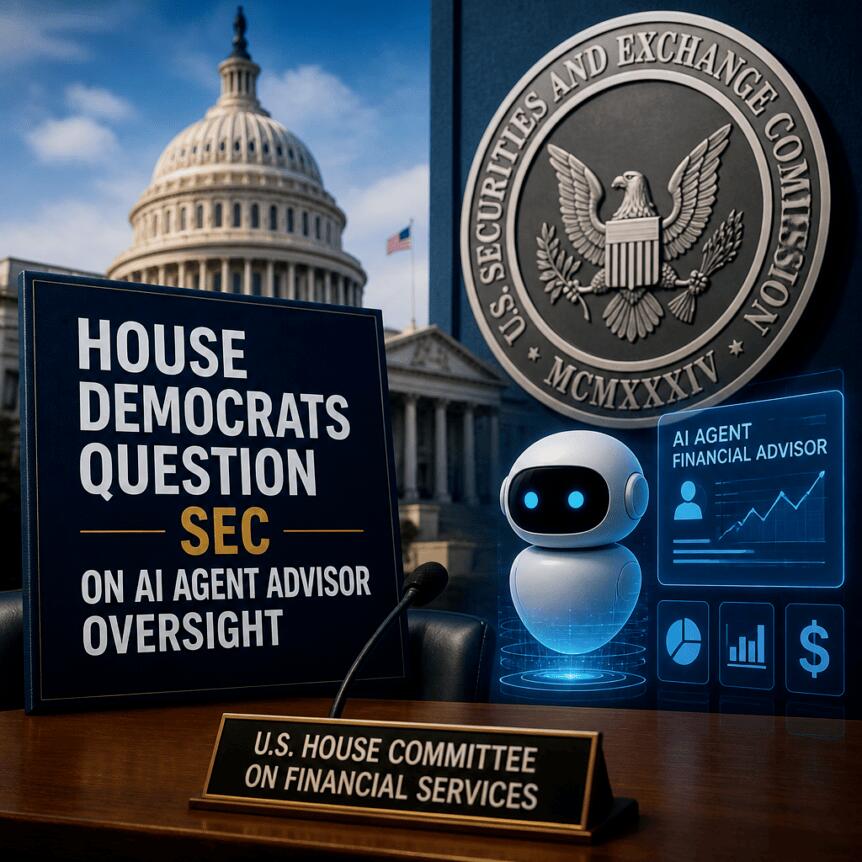
A bipartisan wave of AI tools is moving into retail investing, and U.S. lawmakers are now pressing the Securities and Exchange Commission (SEC) for clarity on how “agentic” trading platforms should be supervised. In a letter to SEC Chair Paul Atkins, a group of Democratic members of the House Financial Services Committee questioned whether the current regulatory framework adequately covers AI-powered investment advice and trading executed on behalf of retail customers.
The lawmakers said that while these tools may begin with limited capabilities, they could rapidly expand into additional asset classes, including cryptocurrency, options, futures, and other derivatives-like products. They warned that the way broker-dealers and AI developers allocate responsibility—especially where platforms disclaim responsibility for outputs—may leave investors insufficiently protected and regulators unclear on enforcement expectations.
Key takeaways
- House Democrats asked the SEC for written answers on how it regulates AI trading agents used by retail investors.
- The letter raises concerns about investor protection, broker-dealer duties, market integrity, and accountability for AI developers.
- Lawmakers highlighted that disclosures often limit platform guarantees and do not clearly establish monitoring, auditing, or responsibility for AI outputs.
- The group requested guidance on when AI agents should register and whether the SEC needs additional authority from Congress.
Why “agentic” trading is drawing SEC scrutiny
The letter centers on AI agents that can initiate or recommend trades based on algorithmic decision-making without traditional human involvement at every step. While the tools may be marketed as convenience features inside consumer trading applications, lawmakers argue they can still produce material trading decisions that affect retail investors.
According to the lawmakers, these systems can operate “largely outside” the securities regulatory framework, even though they are used to make consequential investment choices. The concern is not only technical risk, but regulatory classification: whether the agent’s function constitutes investment advice, brokerage activity, or another regulated service under existing SEC authorities.
From an institutional compliance perspective, the letter underscores a common gap when emerging technologies are deployed quickly: firms may treat AI features as software assistance, while regulators may treat them as advisory or broker-dealer conduct depending on how the product works in practice. That mismatch can create legal uncertainty for both exchanges and AI vendors, particularly around supervisory controls, recordkeeping, and suitability obligations.
Retail-facing tools, disputed responsibility, and the role of disclosures
A focal point of the lawmakers’ concerns is how platforms describe limitations in product disclosures. The letter states that materials accompanying AI agents indicate brokerage platforms cannot guarantee the accuracy or suitability of AI-generated outputs and may not be able to control, monitor, or audit the agents.
Lawmakers argued that such disclaimers raise “urgent questions” about regulatory treatment and create uncertainty about legal responsibility among multiple parties, including brokers, AI developers, and retail investors. This is a key point for risk and governance teams: if an AI system is embedded in a platform that is otherwise acting as a broker or adviser, the platform’s compliance program—supervision, testing, incident response, and documentation—may need to address how the system performs and how it affects client decision-making.
The issue is heightened by the cross-border and cross-entity nature of modern AI deployments. Many AI features are built by third parties, integrated into broker interfaces, and delivered to customers as app functionality. That creates complex lines of accountability, particularly when disclosures attempt to shift responsibility away from the broker.
Scope expansion and crypto’s compliance implications
The letter does not limit the inquiry to traditional equities. Lawmakers warned that agentic trading could expand beyond an initial set of products into others such as options, cryptocurrency, event contracts, and futures. For the crypto industry, this matters because regulatory expectations differ significantly across U.S. agencies and between securities and non-securities products.
The SEC’s jurisdiction is central where the underlying instrument or the advisory conduct implicates U.S. securities laws. But AI agent deployment can also intersect with commodities oversight—especially for crypto-related derivatives and trading structures—bringing the CFTC into the broader enforcement and supervision landscape.
Recent developments illustrate how quickly major crypto platforms are integrating AI features that claim to provide trade guidance. Cointelegraph previously reported that Coinbase introduced an AI agent integrated into its app, describing it as a financial adviser registered with both the SEC and the CFTC that can provide guidance on trades. The lawmakers’ letter points to concerns that such tools may still be effectively operating beyond the securities framework, suggesting that mere registration of an entity or function may not be sufficient if the agent’s behavior, supervision, or outputs are not aligned with regulatory requirements.
For institutional stakeholders, the practical challenge is determining whether existing advice-and-supervision obligations can be met when decision-making is delegated to autonomous or semi-autonomous systems. Compliance programs may need to address questions such as: what constitutes “advice” when generated dynamically; how suitability is assessed when outputs depend on ongoing market signals; and how monitoring is performed when the system’s reasoning cannot be fully controlled by the broker-dealer.
Questions to the SEC and the path toward clearer authority
The House letter—led by Bill Foster, the top Democrat on the House Financial Services Subcommittee on Financial Institutions, and Brad Sherman, the top Democrat on the Capital Markets Subcommittee—requests written responses by July 31. The lawmakers asked for SEC answers covering guardrails and analysis used on AI agent tools, when an AI agent would need to register, and the extent of consultations with broker platforms over AI functionality.
They also asked whether the SEC already has sufficient authority to address the risks posed by AI agents, or whether Congress would need to act to provide additional direction. This is a significant policy point: where regulatory boundaries are uncertain, enforcement can become unpredictable, and firms may face divergent interpretations across jurisdictions.
Representatives Stephen Lynch, Jim Himes, Sean Casten, Rashida Tlaib, Brittany Pettersen, and Sylvia Garcia also signed the letter, signaling that the issue is likely to remain on the agenda for U.S. financial regulators as AI features spread across retail investing platforms.
Closing perspective
For compliance teams and regulated firms, the immediate next step is to monitor the SEC’s written responses and assess whether current AI disclosures, supervisory procedures, and registration positions are sufficient for the regulators’ evolving expectations. The letter also suggests that lawmakers may seek additional legislative or rulemaking action if the agency concludes its existing authority is inadequate to address autonomous trading guidance tools.
This article was originally published as House Democrats Question SEC on AI Agent Advisor Oversight on Crypto Breaking News – your trusted source for crypto news, Bitcoin news, and blockchain updates.


You May Also Like
Digital Currency X Technology Enters Into Securities Purchase Agreement for a Private Placement of US$700 Million of Units, Payable in U.S. Dollars or Digital Assets, to Advance Its Digital Asset Treasury Strategy

Jeers rain down on Sean Duffy over Great American Fair remarks: 'You're garbage'

Binance Coin (BNB) Alert: $620 Support Tested While This New Crypto Hits 3x



