

Peso in Freefall: U.S. Lifeline While Argentina Turns to Crypto

Peso Panic and Milei’s Political Headwinds
The peso slid another 4.5% last week, hammered by doubts over Milei’s ability to push through structural reforms. His party’s weak performance in Buenos Aires provincial elections rattled markets further, as did a corruption probe implicating a family member. With politics in turmoil, capital took flight.
Argentina’s central bank burned through roughly $1.1 billion in just three days to slow the peso’s collapse—no small feat given that liquid reserves are estimated at only $20 billion. Dollar-denominated bonds slumped too, with investors spooked that Milei’s government is spending cash at a clip it simply cannot sustain.
Washington Offers a Safety Net
Against this backdrop, U.S. Treasury Secretary Scott Bessent declared Argentina a “systemically important ally” and hinted that Washington is prepared to step in. Options reportedly on the table include swap lines, direct dollar purchases, and even deploying the Treasury’s Exchange Stabilization Fund to scoop up Argentine government debt.
Markets briefly exhaled. The Merval index popped 9% in dollar terms on Monday, though it remains down nearly 50% year-to-date. Dollar bonds rallied as well. But for critics, this looked like déjà vu: a short-term sugar high propping up a system that still looks unsustainable.
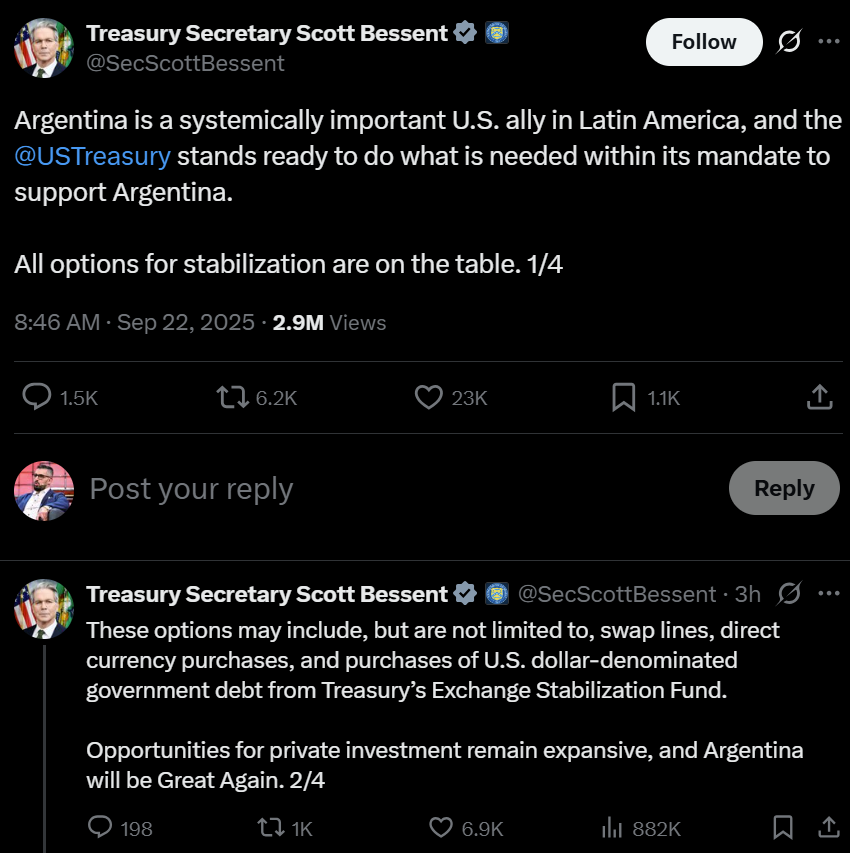
Scott Bessent declared Argentina a “systemically important ally, Source: Scott Bessent
Milei’s Credibility Gap
Milei campaigned as a libertarian firebrand promising radical change, but the reforms have stumbled. His flirtation with controversial crypto projects like LIBRA—later dismissed as a pump-and-dump—triggered federal investigations that dented credibility further.
Saifedean Ammous, author of The Bitcoin Standard, is scathing. He calls Milei’s program a “debt and inflation Ponzi” and points to interest rates soaring to 88% just to sell government debt. Even with inflation lower than when Milei took office in December 2023, the annual rate is still entrenched in double digits. Ammous argues the peso’s collapse since his inauguration proves the libertarian experiment is running out of road.
Argentines Vote With Their Wallets: Stablecoins and Bitcoin
While Washington debates swap lines, ordinary Argentines are voting with their wallets—and they’re voting digital. Stablecoin adoption has exploded as locals flee into dollar-backed tokens to hedge against peso volatility.
Ignacio Gimenez of Lemon, a popular trading app, told Cointelegraph that Sept. 14 marked the platform’s busiest stablecoin-buying day of 2024. “With electoral uncertainty, Argentines continue to turn to stablecoins as a real-time hedge against the political and economic uncertainty that characterizes our country,” he said.
Interestingly, Gimenez noted that while stablecoins dominate as a hedge, Bitcoin has also surged in popularity. “Currently, there are more Argentines with Bitcoin than with crypto dollars on Lemon,” he explained. For some, BTC has even surpassed the dollar as a preferred store of value.
Why Bitcoiners Remain Skeptical
This is where the tension lies. For the U.S. Treasury, the playbook is familiar: intervene, stabilize, extend credit, buy time. For Bitcoiners, it’s precisely this cycle of debt monetization and foreign bailouts that proves why a non-sovereign, hard-capped digital asset is the only true escape valve.
Argentina’s case is especially poignant. With the peso stuck in a managed band of 948–1,475 per dollar, and with political risk rising, the incentives to exit into crypto only strengthen. Stablecoins serve as a bridge to dollar safety; Bitcoin, for the growing number of believers, represents a way out of the entire fiat experiment.
The Bigger Picture
Argentina is not an isolated case. From Turkey to Nigeria, currencies under pressure are pushing citizens toward digital alternatives. The surge in liquid yield tokens (LYTs), stablecoin-based savings products, and crypto adoption reflects a world where trust in central banks is thinning.
The U.S. lifeline may calm markets temporarily, but the deeper question remains: can traditional financial interventions outpace the grassroots migration into borderless digital money? For now, Argentina looks like a test case for both.
You May Also Like

Spot silver falls below the $100 mark

Solana network saw its active addresses more than double to over 5 million in January, with daily transaction volume jumping to 87 million.