TLDR Lyft stock closed at $22.84 on Sept. 17, surging 13%. Waymo to launch robotaxi service with Lyft in Nashville in 2026. Uber shares fell 5% after Lyft’s deal, highlighting rivalry. AV market projected to hit $330B by 2030. Lyft stock up 77% YTD, outpacing Uber’s 48% gain. Lyft, Inc. ($LYFT) stock closed at $22.84 [...] The post Lyft, Inc. ($LYFT) Stock: Surges on Waymo Robotaxi Deal in Nashville appeared first on CoinCentral.TLDR Lyft stock closed at $22.84 on Sept. 17, surging 13%. Waymo to launch robotaxi service with Lyft in Nashville in 2026. Uber shares fell 5% after Lyft’s deal, highlighting rivalry. AV market projected to hit $330B by 2030. Lyft stock up 77% YTD, outpacing Uber’s 48% gain. Lyft, Inc. ($LYFT) stock closed at $22.84 [...] The post Lyft, Inc. ($LYFT) Stock: Surges on Waymo Robotaxi Deal in Nashville appeared first on CoinCentral.

Lyft, Inc. ($LYFT) Stock: Surges on Waymo Robotaxi Deal in Nashville

2025/09/18 21:41
3 min read
For feedback or concerns regarding this content, please contact us at crypto.news@mexc.com

TLDR

  • Lyft stock closed at $22.84 on Sept. 17, surging 13%.

  • Waymo to launch robotaxi service with Lyft in Nashville in 2026.

  • Uber shares fell 5% after Lyft’s deal, highlighting rivalry.

  • AV market projected to hit $330B by 2030.

  • Lyft stock up 77% YTD, outpacing Uber’s 48% gain.

Lyft, Inc. ($LYFT) stock closed at $22.84 on September 17, 2025, soaring 13.13% after news of a robotaxi partnership with Alphabet’s Waymo. Shares rose to $23.05 in pre-market trading, up 0.92%.
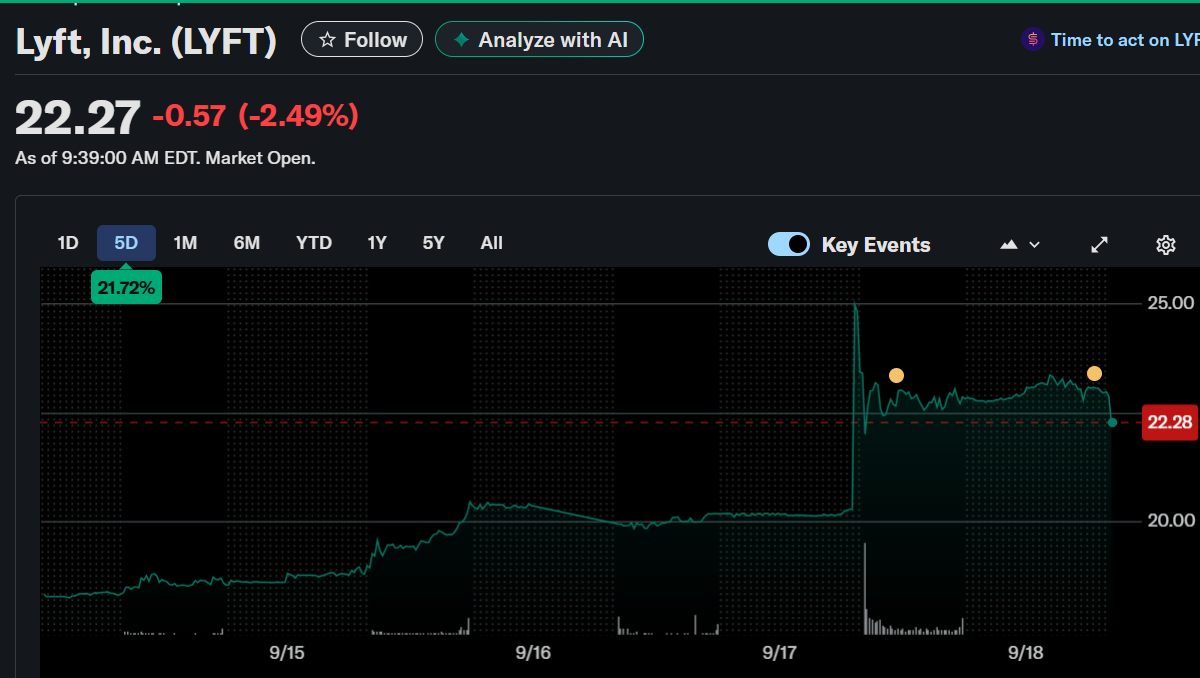
Lyft, Inc. (LYFT)

The surge reflects optimism that the collaboration will strengthen Lyft’s position in the autonomous ride-hailing market against rivals Uber and Tesla.

Waymo Partnership Details

Lyft and Waymo announced plans to roll out driverless ride-hailing in Nashville next year. Riders will initially book through the Waymo app, with integration into Lyft’s platform later in 2026.

As part of the deal, Lyft will provide fleet management services, including maintenance, depot operations, and infrastructure. A new autonomous vehicle facility will also be built to support charging and service needs.

Waymo’s co-CEO Tekedra Mawakana said the rollout is part of a broader strategy to gradually scale the service to more cities.

Competitive Landscape

The robotaxi industry is heating up. Waymo already operates paid services in San Francisco, Phoenix, Los Angeles, and Austin and has partnerships with Uber in Atlanta and Austin.

Tesla began testing its own robotaxi service in Austin this summer with expansion plans for Nevada, Arizona, and Florida. Amazon-backed Zoox continues testing in San Francisco and Las Vegas.

For Lyft, the Waymo deal avoids the high costs and risks of developing autonomous technology internally, allowing it to leverage Waymo’s advanced systems. This positions the company to better compete with Uber’s larger scale and Tesla’s technology-driven model.

Market Potential

Goldman Sachs analyst Mark Delaney estimates the U.S. ride-hailing market is worth about $58 billion today but could grow to $330 billion by 2030, with robotaxi adoption as a key driver. Removing human drivers could significantly reduce costs and improve margins for companies like Lyft.

Analyst View and Challenges

Despite the stock surge, analysts remain cautious. Evercore ISI’s Mark Mahaney maintained an “In Line” rating after Lyft’s mixed Q2 results, questioning whether the company can sustain top-line growth while improving profitability.

Still, Lyft’s performance this year is strong. Shares are up 77% year to date, compared with Uber’s 48% rise. Over the past year, Lyft has gained 86%, though its $9 billion market cap remains far smaller than Uber’s $195 billion.

Performance Overview

Lyft’s five-year return remains negative at -26.89%, underperforming the S&P 500’s 96.61% gain. Yet, the Waymo partnership signals a bold step toward long-term growth in the autonomous era.


The post Lyft, Inc. ($LYFT) Stock: Surges on Waymo Robotaxi Deal in Nashville appeared first on CoinCentral.

Disclaimer: The articles reposted on this site are sourced from public platforms and are provided for informational purposes only. They do not necessarily reflect the views of MEXC. All rights remain with the original authors. If you believe any content infringes on third-party rights, please contact crypto.news@mexc.com for removal. MEXC makes no guarantees regarding the accuracy, completeness, or timeliness of the content and is not responsible for any actions taken based on the information provided. The content does not constitute financial, legal, or other professional advice, nor should it be considered a recommendation or endorsement by MEXC.

You May Also Like

And the Big Day Has Arrived: The Anticipated News for XRP and Dogecoin Tomorrow

And the Big Day Has Arrived: The Anticipated News for XRP and Dogecoin Tomorrow

The first-ever ETFs for XRP and Dogecoin are expected to launch in the US tomorrow. Here's what you need to know. Continue Reading: And the Big Day Has Arrived: The Anticipated News for XRP and Dogecoin Tomorrow
Share
Coinstats2025/09/18 04:33
Swiss Franc Intervention: Critical Analysis of SNB’s 2025 Policy and Safe-Haven Resilience

Swiss Franc Intervention: Critical Analysis of SNB’s 2025 Policy and Safe-Haven Resilience

BitcoinWorld Swiss Franc Intervention: Critical Analysis of SNB’s 2025 Policy and Safe-Haven Resilience ZURICH, March 2025 – The Swiss National Bank faces mounting
Share
bitcoinworld2026/03/16 23:10
Cashing In On University Patents Means Giving Up On Our Innovation Future

Cashing In On University Patents Means Giving Up On Our Innovation Future

The post Cashing In On University Patents Means Giving Up On Our Innovation Future appeared on BitcoinEthereumNews.com. “It’s a raid on American innovation that would deliver pennies to the Treasury while kneecapping the very engine of our economic and medical progress,” writes Pipes. Getty Images Washington is addicted to taxing success. Now, Commerce Secretary Howard Lutnick is floating a plan to skim half the patent earnings from inventions developed at universities with federal funding. It’s being sold as a way to shore up programs like Social Security. In reality, it’s a raid on American innovation that would deliver pennies to the Treasury while kneecapping the very engine of our economic and medical progress. Yes, taxpayer dollars support early-stage research. But the real payoff comes later—in the jobs created, cures discovered, and industries launched when universities and private industry turn those discoveries into real products. By comparison, the sums at stake in patent licensing are trivial. Universities collectively earn only about $3.6 billion annually in patent income—less than the federal government spends on Social Security in a single day. Even confiscating half would barely register against a $6 trillion federal budget. And yet the damage from such a policy would be anything but trivial. The true return on taxpayer investment isn’t in licensing checks sent to Washington, but in the downstream economic activity that federally supported research unleashes. Thanks to the bipartisan Bayh-Dole Act of 1980, universities and private industry have powerful incentives to translate early-stage discoveries into real-world products. Before Bayh-Dole, the government hoarded patents from federally funded research, and fewer than 5% were ever licensed. Once universities could own and license their own inventions, innovation exploded. The result has been one of the best returns on investment in government history. Since 1996, university research has added nearly $2 trillion to U.S. industrial output, supported 6.5 million jobs, and launched more than 19,000 startups. Those companies pay…
Share
BitcoinEthereumNews2025/09/18 03:26