Ethereum just put a timestamp on its ambition, and the new roadmap could shape its price valuation. The Foundation’s new “Strawmap” (roadmap) targets a high-throughputEthereum just put a timestamp on its ambition, and the new roadmap could shape its price valuation. The Foundation’s new “Strawmap” (roadmap) targets a high-throughput

Ethereum 2029 Roadmap: ETH to Become the High-Speed Internet of Value

2026/02/27 17:36
3 min read
For feedback or concerns regarding this content, please contact us at crypto.news@mexc.com

Ethereum just put a timestamp on its ambition, and the new roadmap could shape its price valuation. The Foundation’s new “Strawmap” (roadmap) targets a high-throughput settlement layer by 2029, cutting finality from around 16 minutes to seconds and aiming for 1 gigagas per second directly on Layer 1.

Instead of leaning almost entirely on Layer-2s for speed, Ethereum wants the base layer itself to become faster, tougher, and globally competitive with traditional financial rails.

Key Takeaways

  • The Target: The roadmap aims for 10,000 TPS (1 gigagas/s) on Layer 1 and up to 10 million TPS on Layer 2 via data availability sampling.
  • The Shift: Introduction of “Minimmit” single-slot finality intends to reduce transaction irreversible time from roughly 16 minutes to 6–16 seconds.
  • The Timeline: Developers are planning seven hard forks on a six-month cycle through 2029 to implement these changes incrementally.

The Strawmap or Ethereum Roadmap: 10,000 TPS and Instant Finality

The big number is 10,000 TPS on Layer 1.

The Strawmap targets roughly 1 gigagas per second using zkEVMs and real-time proving. Today, transactions are included quickly but take around 16 minutes to reach finality. The new goal is 6 to 16 seconds, which is critical for serious financial use.

To get there, Ethereum plans up to seven hard forks through 2029. Slot times would gradually fall from 12 seconds to 8, and eventually toward near single-second blocks. That delays any push toward full “ossification” and prioritizes performance.
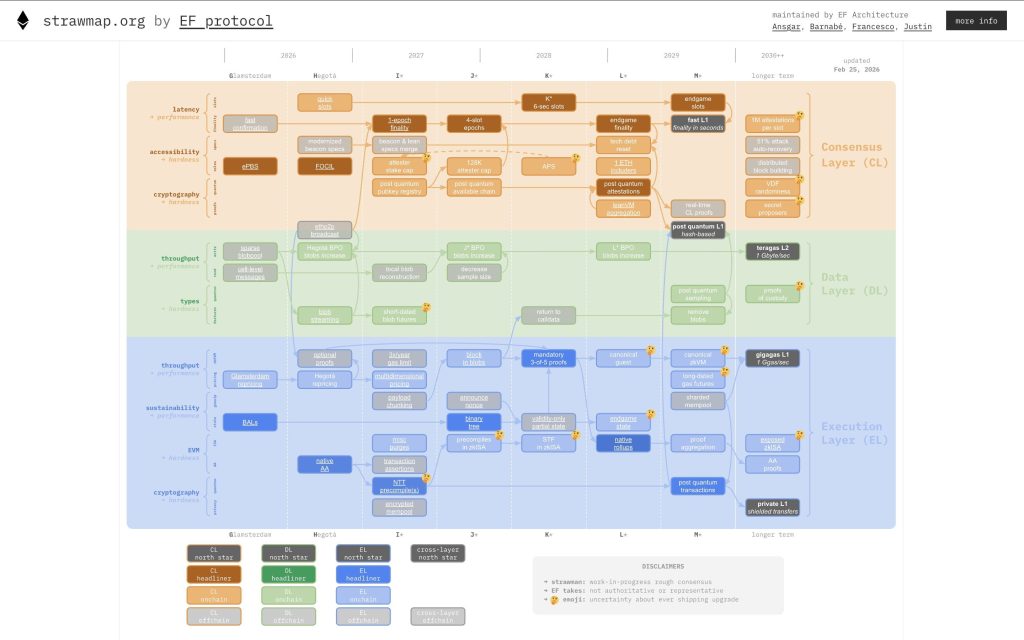
Source: Justin Drake

Vitalik has acknowledged that earlier assumptions about relying almost entirely on L2s need revision. If rollups are expected to process millions of TPS, the base layer must handle far more load itself.

For institutions, the message is clear. Ethereum wants to become a settlement infrastructure capable of supporting heavy, real-world financial flows without congestion.

Ethereum Roadmap: L1 Velocity vs. L2 Scale

For years, the message was simple: scale on Layer 2. The Strawmap adjusts that stance. Scale on L2, but make Layer 1 fast enough so it does not become the bottleneck. Ethereum is reacting to competitive pressure.

Vitalik has acknowledged that earlier assumptions about L2 reliance need updating. If rollups are expected to process millions of TPS, the base layer must comfortably handle around 10,000 TPS. Faster finality also matters for emerging AI-driven use cases, where agents require near-instant settlement to execute complex on-chain strategies.

The proposed shift toward techniques like erasure coding signals a deeper focus on data propagation and network efficiency. If successful, Ethereum strengthens its position as a high-speed settlement layer. If not, it risks ceding performance perception to faster, more centralized alternatives.

Ethereum Price Analysis: The Path to 2029 Valuation

The market reacted fast, with ETH whipping around the $2,060 area after the roadmap dropped. Long term, the plan gives investors a structural anchor. It signals Ethereum does not intend to fall behind faster monolithic chains.

Source: ETHUSD / TradingView

Technically, Ethereum price is compressing. $2,150 is the key resistance. A clean break there opens the path toward $2,400. On the downside, $2,000 is the short-term pivot, and $1,920 to $1,800 is the structural support zone if sentiment turns.

Execution risk matters. If slot-time reductions and early upgrades slip past late 2026, the market could reprice lower. The move toward erasure coding shows the Foundation is tackling core data bottlenecks. If it works, Ethereum strengthens its case as a high-speed settlement infrastructure. If not, it risks being overshadowed by faster alternatives.

For now, holding $2,000 keeps the bullish structure alive. Losing $1,920 would weaken the setup until a new catalyst appears.

Discover: Here are the crypto likely to explode!

Market Opportunity
Ethereum Logo
Ethereum Price(ETH)
$2,111.04
$2,111.04$2,111.04
-1.81%
USD
Ethereum (ETH) Live Price Chart
Disclaimer: The articles reposted on this site are sourced from public platforms and are provided for informational purposes only. They do not necessarily reflect the views of MEXC. All rights remain with the original authors. If you believe any content infringes on third-party rights, please contact crypto.news@mexc.com for removal. MEXC makes no guarantees regarding the accuracy, completeness, or timeliness of the content and is not responsible for any actions taken based on the information provided. The content does not constitute financial, legal, or other professional advice, nor should it be considered a recommendation or endorsement by MEXC.

You May Also Like

The Federal Reserve cut interest rates by 25 basis points, and Powell said this was a risk management cut

The Federal Reserve cut interest rates by 25 basis points, and Powell said this was a risk management cut

PANews reported on September 18th, according to the Securities Times, that at 2:00 AM Beijing time on September 18th, the Federal Reserve announced a 25 basis point interest rate cut, lowering the federal funds rate from 4.25%-4.50% to 4.00%-4.25%, in line with market expectations. The Fed's interest rate announcement triggered a sharp market reaction, with the three major US stock indices rising briefly before quickly plunging. The US dollar index plummeted, briefly hitting a new low since 2025, before rebounding sharply, turning a decline into an upward trend. The sharp market volatility was closely tied to the subsequent monetary policy press conference held by Federal Reserve Chairman Powell. He stated that the 50 basis point rate cut lacked broad support and that there was no need for a swift adjustment. Today's move could be viewed as a risk-management cut, suggesting the Fed will not enter a sustained cycle of rate cuts. Powell reiterated the Fed's unwavering commitment to maintaining its independence. Market participants are currently unaware of the risks to the Fed's independence. The latest published interest rate dot plot shows that the median expectation of Fed officials is to cut interest rates twice more this year (by 25 basis points each), one more than predicted in June this year. At the same time, Fed officials expect that after three rate cuts this year, there will be another 25 basis point cut in 2026 and 2027.
Share
PANews2025/09/18 06:54
SEC Approves Generic Listing Standards for Crypto ETFs

SEC Approves Generic Listing Standards for Crypto ETFs

In a bombshell filing, the SEC is prepared to allow generic listing standards for crypto ETFs. This would permit ETF listings without a specific case-by-case approval process. The filing’s language rests on cryptoassets that are commodities, not securities. However, the Commission is reclassifying many such assets, theoretically enabling an XRP ETF alongside many other new products. Why Generic Listing Standards Matter The SEC has been tacitly approving new crypto ETFs like XRP and DOGE-based products, but there hasn’t been an unambiguously clear signal of greater acceptance. Huge waves of altcoin ETF filings keep reaching the Commission, but there hasn’t been a corresponding show of confidence. Until today, that is, as the SEC just took a sweeping measure to approve generic listing standards for crypto ETFs: “[Several leading exchanges] filed with the SEC proposed rule changes to adopt generic listing standards for Commodity-Based Trust Shares. Each of the foregoing proposed rule changes… were subject to notice and comment. This order approves the Proposals on an accelerated basis,” the SEC’s filing claimed. The proposals came from the Nasdaq, CBOE, and NYSE Arca, which all the ETF issuers have been using to funnel their proposals. In other words, this decision on generic listing standards could genuinely transform crypto ETF approvals. A New Era for Crypto ETFs Specifically, these new standards would allow issuers to tailor-make compliant crypto ETF proposals. If these filings meet all the Commission’s criteria, the underlying ETFs could trade on the market without direct SEC approval. This would remove a huge bottleneck in the coveted ETF creation process. “By approving these generic listing standards, we are ensuring that our capital markets remain the best place in the world to engage in the cutting-edge innovation of digital assets. This approval helps to maximize investor choice and foster innovation by streamlining the listing process,” SEC Chair Paul Atkins claimed in a press release. The SEC has already been working on a streamlined approval process for crypto ETFs, but these generic listing standards could accomplish the task. This rule change would rely on considering tokens as commodities instead of securities, but federal regulators have been reclassifying assets like XRP. If these standards work as advertised, ETFs based on XRP, Solana, and many other cryptos could be coming very soon. This quiet announcement may have huge implications.
Share
Coinstats2025/09/18 06:14
South Korea Halts Trading as Global Markets Plunge

South Korea Halts Trading as Global Markets Plunge

The post South Korea Halts Trading as Global Markets Plunge appeared on BitcoinEthereumNews.com. The Korean Stock Exchange was forced to halt trading after the
Share
BitcoinEthereumNews2026/03/05 07:04
