Lighter’s LIT token has dropped by almost 15% in the last 24 hours, coming after the platform announced its new staking program. While the rollout adds new utilityLighter’s LIT token has dropped by almost 15% in the last 24 hours, coming after the platform announced its new staking program. While the rollout adds new utility

Lighter Token Drops 15% as LIT Staking Goes Live

Lighter’s LIT token has dropped by almost 15% in the last 24 hours, coming after the platform announced its new staking program.

While the rollout adds new utility and ecosystem alignment, the decline is largely driven by post-launch selling and broader market forces.

LIT Staking Rollout: Everything Lighter Users Need to Know

As of this writing, Lighter DEX’s LIT token was trading for $1.85. It is down by almost 14.79% in the last 24 hours. With this drop, Lighter effectively validates the projected 15% drop for the LIT token.
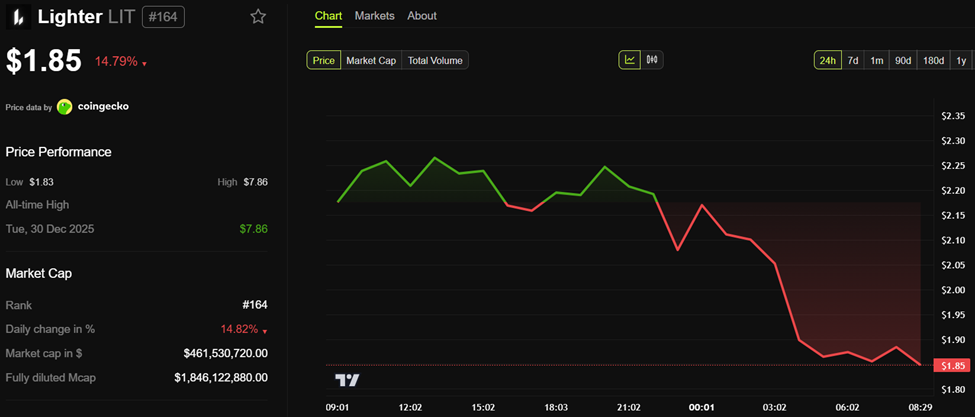
Lighter (LIT) Price PerformanceLighter (LIT) Price Performance. Source: BeInCrypto

It comes only hours after Lighter detailed its staking plans. The network highlighted how LIT holders can now earn rewards and access additional features across the platform. Staking LIT unlocks access to Lighter’s LLP, a key on-chain financial product.

Under the program, for every 1 LIT staked, users can immediately deposit 10 USDC into LLP. Existing LLP holders benefit from a two-week grace period ending January 28. Afterwards, staked LIT will be required to remain in the pool.

According to Lighter, this mechanism is designed to align LIT holders with LLP participants better and enhance risk-adjusted returns.

Similar structures are planned for other public pools as part of the exchange’s goal to “democratize on-chain hedge funds.”

Staking also brings fee incentives. Premium market makers and high-frequency trading (HFT) firms will see discounts on newly adjusted fee tiers, while retail trading remains free.

Lighter plans to publish full details of its premium fee tiers in the coming days, allowing professional traders to adjust their algorithms accordingly.

Additional benefits include zero-fee withdrawals and transfers for users staking 100 LIT, as well as upcoming mobile staking support. Yield will initially be generated from staking rights previously reserved for premium users.

Why LIT Dropped: Post-Launch Selling, FUD, and Staking Volatility

Despite the potential upside from staking, LIT’s price decline reflects a combination of market factors. Post-launch selling and token distribution following the public mainnet launch in October have created significant downward pressure.

Similarly, the Lighter network continues to bear the weight of FUD relating to alleged secret token sales. Its CEO, Valdimir Novakovski, had addressed the issue publicly through Discord. 

Early investors and airdrop recipients sold portions of their holdings, triggering a cascade of market exits. Trading volume has also cooled since the initial launch hype, and technical support levels have been breached, fueling further selling.

The staking announcement itself likely exacerbated the drop, resulting from the ‘buy the rumor, sell the news’ situation, which worsened a period of natural volatility and profit-taking.

Lighter has previously attempted to support the token through buybacks, which began on January 5, as outlined in its tokenomics model.

However, these efforts have so far been insufficient to offset selling pressure. The exchange remains a top contender in the perpetual swaps market, reporting nearly $5 billion in perp volume over the last 24 hours, after competitors Aster ($6.2 billion) and Hyperliquid ($8.8 billion).
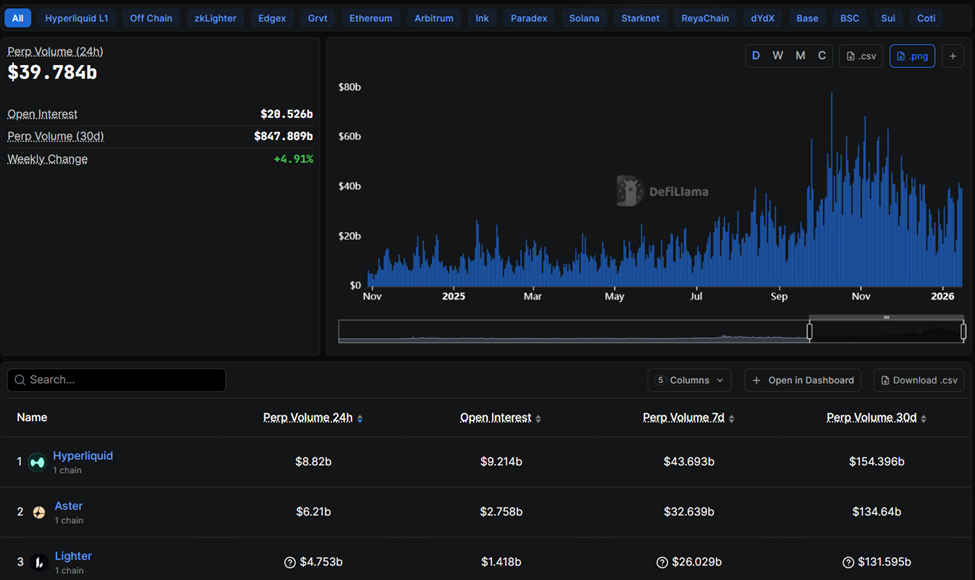
Perp Volume by ProtocolsPerp Volume by Protocols. Source: DefiLlama

In addition, Lighter recently raised $68 million at a $1.5 billion valuation in a round co-led by Founders Fund and Ribbit Capital.

As the platform further develops its LIT ecosystem, the staking rollout represents a key step in integrating token utility with access to financial products.

Market Opportunity
Lighter Logo
Lighter Price(LIT)
$1.842
$1.842$1.842
-4.65%
USD
Lighter (LIT) Live Price Chart
Disclaimer: The articles reposted on this site are sourced from public platforms and are provided for informational purposes only. They do not necessarily reflect the views of MEXC. All rights remain with the original authors. If you believe any content infringes on third-party rights, please contact service@support.mexc.com for removal. MEXC makes no guarantees regarding the accuracy, completeness, or timeliness of the content and is not responsible for any actions taken based on the information provided. The content does not constitute financial, legal, or other professional advice, nor should it be considered a recommendation or endorsement by MEXC.

You May Also Like

The Channel Factories We’ve Been Waiting For

The Channel Factories We’ve Been Waiting For

The post The Channel Factories We’ve Been Waiting For appeared on BitcoinEthereumNews.com. Visions of future technology are often prescient about the broad strokes while flubbing the details. The tablets in “2001: A Space Odyssey” do indeed look like iPads, but you never see the astronauts paying for subscriptions or wasting hours on Candy Crush.  Channel factories are one vision that arose early in the history of the Lightning Network to address some challenges that Lightning has faced from the beginning. Despite having grown to become Bitcoin’s most successful layer-2 scaling solution, with instant and low-fee payments, Lightning’s scale is limited by its reliance on payment channels. Although Lightning shifts most transactions off-chain, each payment channel still requires an on-chain transaction to open and (usually) another to close. As adoption grows, pressure on the blockchain grows with it. The need for a more scalable approach to managing channels is clear. Channel factories were supposed to meet this need, but where are they? In 2025, subnetworks are emerging that revive the impetus of channel factories with some new details that vastly increase their potential. They are natively interoperable with Lightning and achieve greater scale by allowing a group of participants to open a shared multisig UTXO and create multiple bilateral channels, which reduces the number of on-chain transactions and improves capital efficiency. Achieving greater scale by reducing complexity, Ark and Spark perform the same function as traditional channel factories with new designs and additional capabilities based on shared UTXOs.  Channel Factories 101 Channel factories have been around since the inception of Lightning. A factory is a multiparty contract where multiple users (not just two, as in a Dryja-Poon channel) cooperatively lock funds in a single multisig UTXO. They can open, close and update channels off-chain without updating the blockchain for each operation. Only when participants leave or the factory dissolves is an on-chain transaction…
Share
BitcoinEthereumNews2025/09/18 00:09
How ZKP’s Daily Presale Auction Is Creating a New Standard for 1,000x Returns

How ZKP’s Daily Presale Auction Is Creating a New Standard for 1,000x Returns

The post How ZKP’s Daily Presale Auction Is Creating a New Standard for 1,000x Returns appeared on BitcoinEthereumNews.com. Disclaimer: This article is a sponsored
Share
BitcoinEthereumNews2026/01/16 09:02
Lighter drops 14% after losing $2 support – More pain ahead for LIT?

Lighter drops 14% after losing $2 support – More pain ahead for LIT?

The post Lighter drops 14% after losing $2 support – More pain ahead for LIT? appeared on BitcoinEthereumNews.com. Since it touched a high of $4.5, Lighter has
Share
BitcoinEthereumNews2026/01/16 08:46