

Mass Schooling Invented “Smart” and “Dumb”: Here's How It Happened
Five years ago, I raised my IQ test score by 50-70 points with effort. I became arrogant and prideful; I would tell people that they’re illogical or factually incorrect.
\ If I were so smart, why was I not top of the class? Neat? Organised? Friendly? Or focused?
\ After all, “the only true test of intelligence is if you get what you want out of life.” - Naval.
\ This quote is only a useful heuristic, and I enjoy quoting it because it’s pragmatic.
\ But you cannot infer the definition of intelligence as the ability to get what you want out of life.
Intelligence is not objective.
Intelligence is not a scalar quantity; it is a high-dimensional cluster of many skills. Its relevance depends on the problem domain and the feedback loops available.
\ It is flawed to think that you are smarter than guys who dance on TikTok because you read essays like these, or to have titles like “most gifted children in the world.” Have you met all the children? Or do you have a criterion that can reach those you don’t meet?
\ If I’m quick at making funny jokes, and you are quick at math, neither of us is “smarter.”
\ Schools, governments, and media would insist that some kids are “gifted” and others are not.
\ This essay is a historical autopsy of that story. I will show you that the sharp divide between “smart” and “dumb” is barely two centuries old, that it emerged for boring institutional reasons rather than deep truths about human potential, and that most barriers we treat as “not smart enough” are products of 19th-century mass schooling and a handful of poor proxies.
\ Except for the obvious exceptions: people with neurological disabilities, a handful of James Sidis-level outliers, and so on. But they are dwarfed by the number of people who were never given the environment, incentives, or time to develop the skills that mattered for what they really want.
Who was smart and who was dumb 500 years ago?
Some might think that the scribes, physicians, and philosophers were smart and the carpenters, bakers, and blacksmiths were less smart. But that is false.
\ Why have we built AI models that can do writing and library organizing before AI blacksmiths and carpenters?
\ A blacksmith must understand metallurgy, heat tolerance, geometry, muscle memory, and so on.
\ One’s job does not make one mentally superior to another.
\ If you wanted to learn to make fire, then you would watch someone making fire, and you would follow their guidance. If you wanted to learn to hunt, you would go hunting with your tribe.
\ If you wanted to learn blacksmithing, you apprenticed to a blacksmith.
\ If you wanted medicine, you followed a physician or midwife.
\ There was no entrance examination or report card. You were judged only on whether you could eventually produce work that didn’t break, kill the patient, or burn the house down. Feedback was swift, concrete, and often expensive.
The Origin of Mass Schooling
Status barriers came from our status games. Some jobs were set apart for a particular guild, caste, or gender.
\ Even then, learning still happened through imitation and long apprenticeships. A rich boy who couldn’t visit the blacksmith’s shop and a poor girl who couldn’t attend the university were both excluded by politics, not by any theory that their brains were unsuited for the craft.
\ The Spartans, the Aztec telpochcalli, Jesuit colleges, and the Prussian Volksschule systems were the roots of our modern school system.
\ Their explicit purpose was to produce obedient soldiers and civil servants who would follow orders without question.
\ Prussia had a remarkable military victory over France in 1870, leading many nations to believe its educational design was key to national power.
\ So, they copied them. They copied their bells, uniforms, rigid schedules, age cohorts, and centralised curriculum. Britain, France, and the United States were the first nations to adopt the educational system.
\ Mass schooling was about producing a predictable distribution of human raw material for factories and bureaucracies.
The “DUMB” Equation
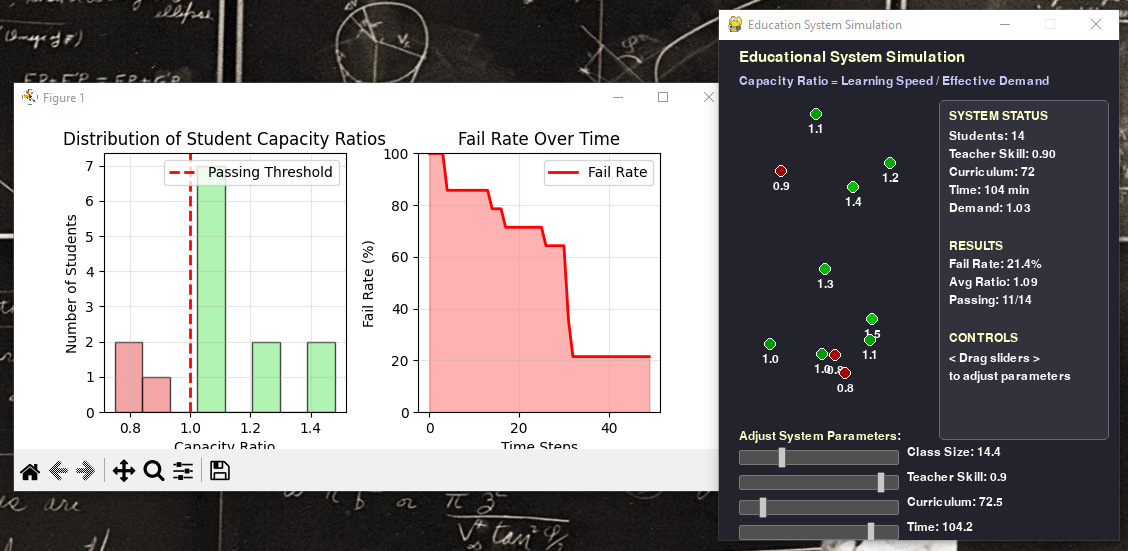
\ School is an attempt to make education “scalable” and affordable. Thirty children are to be taught one curriculum at once, in age groups and uniforms, while the teacher has to rush through the subject before the bell rings.
\ Within this system, it is unlikely that every student will understand and/or have an interest in the problems written on the blackboard. This makes them feel foolish and sad.
\ Anybody who couldn’t catch up to the average speed of the class (which depends on the teacher’s skill and class size) wouldn’t pass and would be labelled “dumb.”
\ Mathematically:
\ 
Students and teachers optimize for what would be written on their piece of paper, and they take shortcuts.
\ The modern concept of fixed, general intelligence is an artefact of industrial sorting technology.
IQ Tests.
IQ tests were not made to measure deep, immutable “brain power.” The first version was built by Alfred Binet in 1905 for one specific purpose: to spot Parisian schoolchildren who would struggle with the standard curriculum so they could get extra help.
\ The test had been hijacked by armies and schools within 20 years.
\ Stanford-Binet, WAIS, Raven’s matrices, etc., that are present today measure the same four things: vocabulary, arithmetic, block design, and matrix reasoning. These are the fundamental skills required for 19th-century schooling and bureaucratic work. IQ tests won’t help you measure anything else.
\ Plus, like other skills, they are trainable.
- My own score on common online Raven‘s-style tests jumped 50-70 points in about four months of practice in 2020-2021.
- Dual n-back training studies show 10-20 point gains on matrix tests that last for months.
- Norway military data shows IQ rising roughly 3 points per decade.
\ IQ tests have statistical malpractice rooted in them. The kind of techniques you can find in Darrel Huff’s book on How to Lie with Statistics:
- The sample is biased: Questions are chosen because they correlate with school grades in 1920s America or Britain. If you didn’t grow up in that cultural context, you lose points.
- The “average” is forced to 100 every generation by renorming.
- Ceiling and floor effects hide variance at the tails.
- Reproducibility of the exact test results in a short time is high; reproducibility across different tests or after years away is mediocre. The skill decays when you stop drilling it. I retook some online tests while writing this section and scored 138 and 163.
\ Even if you designed some stable and well-measured IQ tests (there are some impressive ones written by folks with 190+ SD15 IQ), it would still be a terrible metric compared to what actually matters.
\ They can predict who will do well in mass schooling (that’s what they were made for), but can’t predict who will build a great company, raise happy children, compose music, and solve the world’s most important problems.
Teach Yourself
We no longer have the excuses that justified mass schooling and IQ sorting in 1900.
\ Khan Academy, YouTube, AI tutors, open-source codebases, and real-time feedback from global markets mean anyone with an internet connection can now access the world’s best teachers in any subject. At their pace.
\ Pick something you actually want.
\ Find the ten people alive who are best at it.
\ Study and cherry-pick what they do; learning will be so interesting that you may forget to eat or sleep.
\ Measure your output.
\ Iterate ruthlessly.
\ That loop beats any score or childhood label.
\ I did it with writing, programming, science, and a few other things after I stopped caring about matrix puzzles. My life got dramatically better.
\ The barrier was never your brain.
\ Cheers.
\ —Praise
\ Share this essay, and subscribe to my weekly newsletter: https://crive.substack.com
You May Also Like

X to cut off InfoFi crypto projects from accessing its API

X Just Killed Kaito and InfoFi Crypto, Several Tokens Crash
