Tether real estate tokenization enters Saudi Arabia
Overview
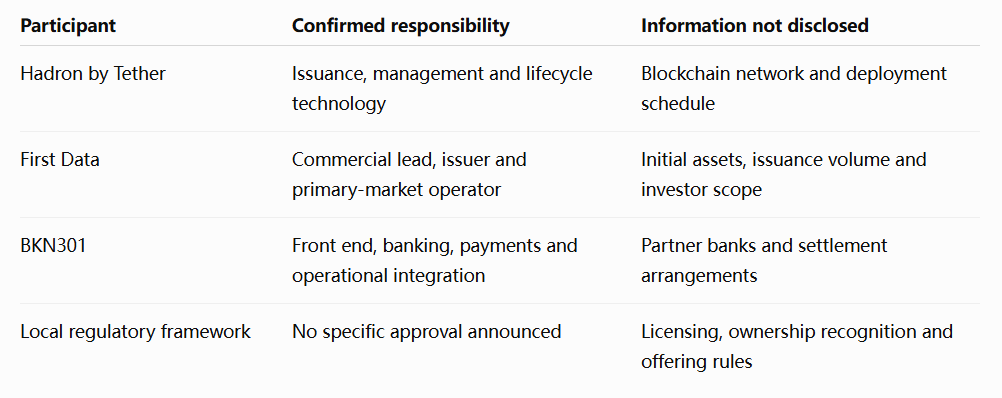
Tether announced on August 6, 2026, that Hadron by Tether will support a strategic collaboration with First Advanced Data for Artificial Intelligence LLC, known as First Data, and BKN301 to develop institutional-grade tokenized real estate in Saudi Arabia. Hadron will supply the issuance and asset-lifecycle technology, while First Data will lead commercial operations, act as the issuer and operate the primary market. BKN301 will connect the platform with front-end services, banking infrastructure, payments, compliance processes and operational systems.
The initiative expands Tether real estate tokenization into a market where property development, financial modernization and economic diversification are central to Saudi Vision 2030. It also reflects Tether’s broader effort to position Hadron as infrastructure for real-world assets rather than limiting its business to stablecoin issuance.
However, the announcement describes a strategic infrastructure deployment, not a completed property offering. The partners have not disclosed the first underlying assets, issuance volume, blockchain network, eligible investors, launch date or secondary-market arrangements. The project could reduce administrative and settlement friction, but tokenization alone will not guarantee liquidity, regulatory approval or wider access.
Key Takeaways
- Hadron will provide the technology for issuing and administering tokenized real estate assets.
- First Data will serve as commercial lead, issuer and primary-market operator.
- BKN301 will provide banking, payment, compliance and front-end integration.
- No initial asset, issuance size, launch date or secondary-market venue has been announced.
- Liquidity will depend on investor access, market making, valuation and redemption arrangements.
How Tether real estate tokenization will operate
Hadron by Tether handles issuance and lifecycle management
Hadron is the technology layer of the initiative rather than the owner of the underlying real estate. According to Tether, the platform is designed to support the issuance and management of tokenized assets throughout their lifecycle. Its role may include creating digital representations of assets, administering investor permissions, enforcing transfer restrictions and maintaining records needed for compliance and reporting.
For institutional property, the legal and operational structure matters as much as the blockchain. A token could represent direct ownership, a beneficial interest in a special-purpose vehicle, a debt claim secured by property or another contractual right. Each model produces different governance, income-distribution, valuation and redemption implications. The partners have not yet specified which structure will be used.
Tether real estate tokenization therefore should not be interpreted as placing a property deed directly on a public blockchain. Hadron can provide programmable issuance and administration, but legal agreements and recognized ownership records must still connect each token to enforceable rights over the asset.
First Data and BKN301 connect assets with financial rails
First Data will act as the commercial lead, issuer and primary-market operator. This places it between property owners, investors and the Hadron infrastructure. Its responsibilities are expected to include identifying suitable assets, structuring offerings, coordinating issuance and managing primary-market participation.
BKN301 will support integration, orchestration, user-facing services, banking connectivity and operational processes. This layer is essential because institutional tokenization cannot function through smart contracts alone. Investors must be onboarded, payments must be received, eligibility restrictions must be enforced and distributions must move between blockchain systems and conventional bank accounts.
The division of responsibilities illustrates the operating model behind Tether real estate tokenization: Hadron provides tokenization infrastructure, First Data organizes the asset and market structure, and BKN301 connects the product to financial and compliance systems. The model could eventually be extended to energy, infrastructure financing and other real-world assets, although real estate is the only confirmed starting segment.
Why Saudi Arabia is an important tokenization market
How does the project align with Saudi Vision 2030?
The project aligns with the broad direction of Saudi Vision 2030 by supporting financial digitalization, new capital-formation channels and greater use of technology in traditional asset markets. This alignment is strategic rather than evidence that a particular tokenized property product has received regulatory approval.
Saudi Arabia has a substantial real estate development pipeline associated with housing, tourism, commercial infrastructure and large-scale economic projects. Tokenization could provide asset owners with an additional method of structuring ownership or financing, particularly when a property can be divided into smaller digital interests.
The initiative may also help connect local assets with a wider institutional investor base. That outcome would require compliant distribution rules, suitable cross-border access and recognized settlement arrangements. The official announcement refers to attracting local and international investors, but it does not establish that international participation has already been authorized.
Real estate provides scale but creates liquidity constraints
Real estate is a natural target for tokenization because conventional transactions involve high minimum investments, extensive documentation, slow settlement and limited divisibility. Digital tokens can make ownership interests easier to divide and may automate transfers, investor records and income distributions.
Does tokenizing real estate make it liquid? No. Tokenization can reduce operational friction, but it cannot create buyers, reliable prices or redemption capacity by itself. A tokenized property market still needs qualified investors, transparent valuations, trading venues, custody arrangements and market makers willing to quote executable prices.
Property assets also generate asset-specific risks that cannot be removed through technology. Occupancy, rental income, maintenance costs, development delays and local property cycles continue to determine economic performance. If a token trades continuously while the underlying property is valued only periodically, its market price may diverge from the reported net asset value.
Tether real estate tokenization could improve the infrastructure for ownership and transfer, but actual market depth will depend on the quality of the assets and the design of the investment product. Smaller denominations may broaden technical accessibility without necessarily making an offering legally available to retail investors.
What Tether real estate tokenization does not yet prove
Regulation, custody and ownership remain key tests
The announcement does not specify which Saudi regulator would oversee an offering, what licenses the participating entities would rely on or how the token would be treated under securities and property rules. Those questions must be resolved before investors can assess the product’s legal status.
A scalable structure must establish a clear link between the token, the issuing entity and the underlying property. It must also define what happens if the issuer, platform provider or custodian fails. Token holders need enforceable rights to income and assets rather than relying only on a blockchain balance.
Custody presents another layer of risk. Institutional investors may require qualified custody, controlled wallets, recovery procedures and separation between client assets and company funds. Permissioned transfers could support compliance, but they may also reduce interoperability with public decentralized finance markets.
Sharia compliance cannot be assumed from strategic alignment
Saudi Arabia’s financial market operates within an environment where Sharia considerations can materially affect product design. A real estate-backed structure may be compatible with Islamic finance principles, but compliance depends on the contractual arrangement, financing method, income sources and supervision process.
The announcement does not identify a Sharia board or state that a specific product has received independent certification. References to building Islamic financial infrastructure or supporting Saudi economic objectives should therefore not be treated as product-level approval.
Before the initiative scales, investors should look for details on the ownership vehicle, revenue-sharing model, debt exposure and use of proceeds. An independent Sharia review may also be necessary, depending on the structure and intended investor base.
Tether’s Saudi expansion is infrastructure first
The immediate significance of the partnership is that it connects a global tokenization platform with local issuance capabilities and banking, payment and compliance infrastructure. This combination addresses an important weakness in many real-world asset projects: creating a token is relatively simple, but connecting it to enforceable ownership, regulated distribution and reliable financial operations is considerably harder.
Tether real estate tokenization may eventually reduce the cost and time required to issue, administer and transfer interests in Saudi property. It could also demonstrate how Hadron can move beyond isolated blockchain experiments and operate within conventional financial systems. Nevertheless, the announcement does not yet establish investor demand, regulatory acceptance or secondary-market liquidity.
The most important next indicators will be the identity and value of the first assets, the legal rights represented by each token, the blockchain and custody architecture, investor eligibility, issuance volume and trading arrangements. On-chain activity, distributions and redemption performance will provide stronger evidence than the partnership announcement alone.
The project should therefore be viewed as an infrastructure commitment with meaningful potential but limited operating data. Its long-term importance will depend on whether the partners can convert technical integration into regulated offerings with transparent assets, enforceable investor rights and sustainable market participation.
Sources
Risk Disclaimer: This article is for reference only and does not constitute investment advice. The cryptocurrency market is highly volatile. Please make decisions cautiously based on your individual circumstances.
You May Also Like
Gold Price Breaks $4,300 as Traders Reprice the Fed, Oil Risk, and Safety Demand
US CPI, PPI, and Retail Sales: Complete Macro Trade Guide for the Week Ahead (May 12-15)

Can Arsenal F.C. Win the 2026 Premier League Title? A Data-Driven Analysis Using MEXC Prediction Markets