BlackRock debuted its staked Ethereum ETF on Nasdaq with $100 million in initial assets and $16 million in day-one volume, but signalled a cautious approach movingBlackRock debuted its staked Ethereum ETF on Nasdaq with $100 million in initial assets and $16 million in day-one volume, but signalled a cautious approach moving

BlackRock Signals Cautious Expansion of Crypto ETFs Despite New Staked Ether Fund

2026/03/16 12:55
3 min read
For feedback or concerns regarding this content, please contact us at crypto.news@mexc.com
  • BlackRock’s iShares Staked Ethereum Trust ETF (ETHB) began trading on Nasdaq on March 13 with US$100 million in initial assets and roughly US$16 million in day-one volume.
  • The fund stakes up to 95% of its ETH holdings via Coinbase Prime, delivering approximately 3.1% annual yield to investors.
  • BlackRock’s Robert Mitchnick confirmed the firm will take a “discerning approach” to new crypto ETFs and will not pursue exotic fund structures.

BlackRock said it is taking a cautious approach to expanding its digital asset products. The firm’s head of digital assets, Robert Mitchnick, said the company will evaluate potential future launches selectively. 

He described Ethereum as primarily a technology-focused investment tied to blockchain innovation, contrasting it with Bitcoin’s role as a store-of-value asset.

Will we see some more exotic structures coming into the space? I think there is no question. Some of those will be interesting. Some of them will resonate with investors. But we will take a discerning approach in thinking about where else we would expand in this.

Robert Mitchnick, Head of DIgital Assets at BlackRock.

The company’s earlier crypto ETFs have attracted significant capital, with the iShares Bitcoin Trust (IBIT), launched in January 2024, recording about US$55 billion (AU$84.15 billion) in inflows. 

Read more: Wells Fargo Signals Crypto Expansion With ‘WFUSD’ Trademark Filing

Meanwhile, the iShares Ethereum Trust (ETHA), introduced in July 2024, has accumulated roughly US$6.5 billion (AU$9.95 billion) in assets.

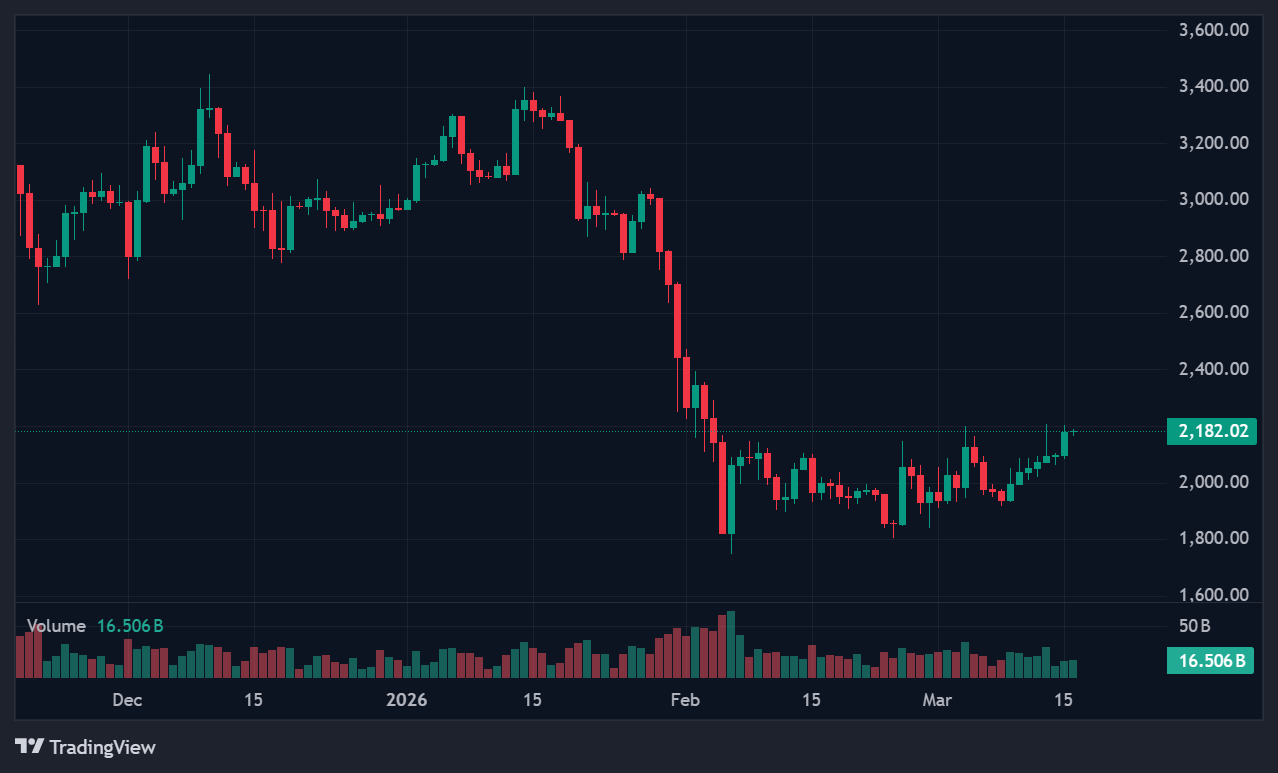
Moderately successful, hence why BlackRock said the staking component is intended to provide investors with income alongside exposure to ETH’s price, but the product launches at a time when ETH trades near US$2,096 (AU$3,207), significantly below its August 2025 peak of about US$4,950 (AU$7,574).
Source: TradingView.

Staking ETF in a Weak Ethereum Market

BlackRock launched its third cryptocurrency exchange-traded fund on March 13, listing the iShares Staked Ethereum Trust ETF (ETHB) on Nasdaq with US$100 million (AU$153 million) in seed capital.

The fund generated roughly US$16 million (AU$24.5 million) in trading volume on its first day, which Bloomberg Intelligence analyst James Seyffart described as a strong debut for a new ETF.

ETHB holds spot ETH and stakes between 70% and 95% of its holdings on the Ethereum network through Coinbase Prime. Investors receive about 82% of the gross staking rewards, which equates to an estimated annual yield of around 3.1% at current rates. BlackRock and Coinbase share the remaining 18% as a staking fee.

The ETF charges a sponsor fee of 0.25%, though a temporary promotional rate of 0.12% will apply during the first year or until the fund reaches US$2.5 billion (AU$3.83 billion) in assets.

Read more: India Arrests Darwin Labs Co-Founder in $2.4B GainBitcoin Scam Investigation

Across all digital asset exchange-traded products, BlackRock now manages about US$130 billion (AU$198.9 billion) and accounted for around 95% of inflows into crypto ETPs during 2025.

The firm’s next planned crypto offering is a Bitcoin Premium Income ETF that will use covered call options on BTC futures to generate yield. 

The post BlackRock Signals Cautious Expansion of Crypto ETFs Despite New Staked Ether Fund appeared first on Crypto News Australia.

Disclaimer: The articles reposted on this site are sourced from public platforms and are provided for informational purposes only. They do not necessarily reflect the views of MEXC. All rights remain with the original authors. If you believe any content infringes on third-party rights, please contact crypto.news@mexc.com for removal. MEXC makes no guarantees regarding the accuracy, completeness, or timeliness of the content and is not responsible for any actions taken based on the information provided. The content does not constitute financial, legal, or other professional advice, nor should it be considered a recommendation or endorsement by MEXC.

You May Also Like

Steel Dynamics (STLD) Stock Dips Following Disappointing Q1 Earnings Forecast

Steel Dynamics (STLD) Stock Dips Following Disappointing Q1 Earnings Forecast

Steel Dynamics (STLD) stock dropped 1.3% premarket after issuing Q1 EPS guidance of $2.73–$2.77, significantly below the $3.24 Wall Street consensus. The post Steel
Share
Blockonomi2026/03/17 21:45
Hadron Labs Launches Bitcoin Summer on Neutron, Offering 5–10% BTC Yield

Hadron Labs Launches Bitcoin Summer on Neutron, Offering 5–10% BTC Yield

Hadron Labs launches 'Bitcoin Summer' on Neutron, BTC vaults for WBTC, eBTC, solvBTC, uniBTC and USDC. Earn 5–10% BTC via maxBTC, with up to 10x looping.
Share
Blockchainreporter2025/09/18 02:00
EUR/CHF slides as Euro struggles post-inflation data

EUR/CHF slides as Euro struggles post-inflation data

The post EUR/CHF slides as Euro struggles post-inflation data appeared on BitcoinEthereumNews.com. EUR/CHF weakens for a second straight session as the euro struggles to recover post-Eurozone inflation data. Eurozone core inflation steady at 2.3%, headline CPI eases to 2.0% in August. SNB maintains a flexible policy outlook ahead of its September 25 decision, with no immediate need for easing. The Euro (EUR) trades under pressure against the Swiss Franc (CHF) on Wednesday, with EUR/CHF extending losses for the second straight session as the common currency struggles to gain traction following Eurozone inflation data. At the time of writing, the cross is trading around 0.9320 during the American session. The latest inflation data from Eurostat showed that Eurozone price growth remained broadly stable in August, reinforcing the European Central Bank’s (ECB) cautious stance on monetary policy. The Core Harmonized Index of Consumer Prices (HICP), which excludes volatile items such as food and energy, rose 2.3% YoY, in line with both forecasts and the previous month’s reading. On a monthly basis, core inflation increased by 0.3%, unchanged from July, highlighting persistent underlying price pressures in the bloc. Meanwhile, headline inflation eased to 2.0% YoY in August, down from 2.1% in July and slightly below expectations. On a monthly basis, prices rose just 0.1%, missing forecasts for a 0.2% increase and decelerating from July’s 0.2% rise. The inflation release follows last week’s ECB policy decision, where the central bank kept all three key interest rates unchanged and signaled that policy is likely at its terminal level. While officials acknowledged progress in bringing inflation down, they reiterated a cautious, data-dependent approach going forward, emphasizing the need to maintain restrictive conditions for an extended period to ensure price stability. On the Swiss side, disinflation appears to be deepening. The Producer and Import Price Index dropped 0.6% in August, marking a sharp 1.8% annual decline. Broader inflation remains…
Share
BitcoinEthereumNews2025/09/18 03:08