With markets getting hit again, it’s easy to fall into chart-watching mode and treat every dip like a verdict. Analyst David took the opposite route in his latestWith markets getting hit again, it’s easy to fall into chart-watching mode and treat every dip like a verdict. Analyst David took the opposite route in his latest

The Math Says Bitcoin Is Deeply Mispriced

With markets getting hit again, it’s easy to fall into chart-watching mode and treat every dip like a verdict. Analyst David took the opposite route in his latest post. He focused on a long-horizon valuation lens that tries to answer a different question: is Bitcoin’s current price sitting far away from its historical “gravity line,” or is this just normal noise?

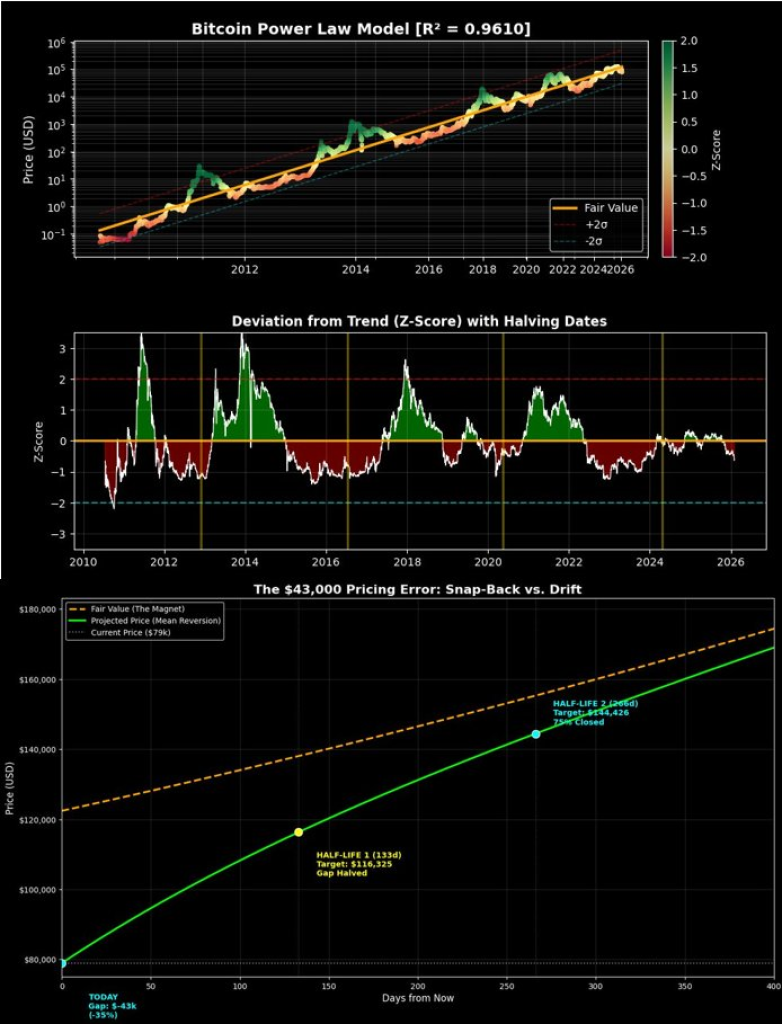
His chart stacks three views of the same idea: a 15-year power-law trend, a deviation gauge (Z-score), and a mean-reversion path that estimates how fast big pricing gaps have closed in the past.

Chart 1: The power-law “fair value” line

The top panel is labeled “Bitcoin Power Law Model (R² = 0.9610)” and it’s plotted on a log scale. That matters. A log scale compresses huge moves and makes long-term structure easier to see, which is useful for an asset that has gone from pennies to tens of thousands.

You can see three key ingredients:

First is the price history (the colored path). The color bar on the right maps Z-score values, so green zones sit above trend and red zones sit below.

Second is the “Fair Value” line (the orange/yellow line). David treats this as the long-run trend Bitcoin has gravitated around across multiple cycles.

Third are the bands around that line, marked +2σ and −2σ. Those act like a historical “lane.” When price hugs the upper band, the market has been stretched to the upside. When it presses the lower band, it has been stretched to the downside.

David’s main claim comes from where price sits today versus that fair-value line. In his notes, he puts fair value near $122K and spot near $79K, creating a gap of roughly $43K.
Source: X/@david_eng_mba

Chart 2: Deviation from trend and where we sit now

The middle panel, “Deviation from Trend (Z-Score) with Halving Dates,” turns the same story into a single oscillator. The orange horizontal line is the trend itself (Z = 0). Readings above zero mean price is above trend; readings below zero mean price is below trend.

The visual pattern is familiar. Big cycle peaks push Z-score into positive extremes, then cooling phases drag it down into negative territory. The vertical yellow markers show halving dates, giving you an anchor for where these swings landed across eras.

David labels the current reading as oversold with a Z-score around −0.63. That is not “capitulation territory” in the classic sense (you can see past moments that went far lower), but it does place price on the undervalued side of the long-term line.

The key takeaway from this panel isn’t “it must bounce tomorrow.” It’s that the market is currently pricing Bitcoin below a trendline that has held up through multiple booms and busts.

Read also: Here’s How High Ripple’s XRP Price Can Go This Week

Chart 3: “Snap-back vs. drift” and the half-life idea

The bottom panel is the most ambitious part. It’s titled “The $43,000 Pricing Error: Snap-Back vs. Drift.” Here David frames the gap between spot and fair value as an error that historically shrinks over time.

There are three lines to watch:

The dashed orange path is drift: a slow grind higher that never fully “catches” the fair-value line quickly.

The green curve is mean reversion: a faster catch-up path that closes a big part of the gap earlier, then slows as it gets closer to trend.

And the fair-value “magnet” sits above them, acting like the reference point the model tries to return toward.

He adds two labeled checkpoints based on an estimated half-life of 133 days. In simple terms, half-life is the time it took, on average, for half of a mispricing gap to close in past episodes that looked similar.

On the chart, the first checkpoint sits around 133 days with the note “Gap Halved,” and the second sits around roughly 266 days with “Gap Cflosed.” From that, he projects a path that reaches the low-to-mid $100Ks later in 2026 and pushes higher into early 2027.

Even if you ignore the exact price targets, the mechanical point is clear: when Bitcoin has sat meaningfully below its long-run trend, it hasn’t tended to stay there for long stretches. The model expects the gap to compress, and it tries to quantify the pace.

What’s strong here, and what to be careful with

This framework has two real strengths.

One, it forces a long-term view. Most people only zoom in during drawdowns, which makes every move feel existential. A 15-year lens reminds you Bitcoin has lived through long bear markets and still maintained an upward adoption curve.

Two, the deviation panel gives a clean “where are we on the spectrum” gauge. It’s a useful way to compare today with prior cycles without getting lost in narratives.

That said, this is not a guaranteed roadmap.

R² being high does not mean the model can call the next 3–6 months with precision. It means the trendline fits the broad history well. Markets can stay below “fair value” longer than traders expect, especially in ugly macro stretches.

Mean reversion also depends on the sample you choose. Bitcoin has a limited number of full cycles, and the market structure keeps changing as it grows. What looked like a clean snap-back in earlier eras can turn into a slower grind in a more mature market.

Subscribe to our YouTube channel for daily crypto updates, market insights, and expert analysis.

The post The Math Says Bitcoin Is Deeply Mispriced appeared first on CaptainAltcoin.

Disclaimer: The articles reposted on this site are sourced from public platforms and are provided for informational purposes only. They do not necessarily reflect the views of MEXC. All rights remain with the original authors. If you believe any content infringes on third-party rights, please contact service@support.mexc.com for removal. MEXC makes no guarantees regarding the accuracy, completeness, or timeliness of the content and is not responsible for any actions taken based on the information provided. The content does not constitute financial, legal, or other professional advice, nor should it be considered a recommendation or endorsement by MEXC.

You May Also Like

Let insiders trade – Blockworks

Let insiders trade – Blockworks

The post Let insiders trade – Blockworks appeared on BitcoinEthereumNews.com. This is a segment from The Breakdown newsletter. To read more editions, subscribe ​​“The most valuable commodity I know of is information.” — Gordon Gekko, Wall Street Ten months ago, FBI agents raided Shayne Coplan’s Manhattan apartment, ostensibly in search of evidence that the prediction market he founded, Polymarket, had illegally allowed US residents to place bets on the US election. Two weeks ago, the CFTC gave Polymarket the green light to allow those very same US residents to place bets on whatever they like. This is quite the turn of events — and it’s not just about elections or politics. With its US government seal of approval in hand, Polymarket is reportedly raising capital at a valuation of $9 billion — a reflection of the growing belief that prediction markets will be used for much more than betting on elections once every four years. Instead, proponents say prediction markets can provide a real service to the world by providing it with better information about nearly everything. I think they might, too — but only if insiders are free to participate. Yesterday, for example, Polymarket announced new betting markets on company earnings reports, with a promise that it would improve the information that investors have to work with.  Instead of waiting three months to find out how a company is faring, investors could simply watch the odds on Polymarket.  If the probability of an earnings beat is rising, for example, investors would know at a glance that things are going well. But that will only happen if enough of the people betting actually know how things are going. Relying on the wisdom of crowds to magically discern how a business is doing won’t add much incremental knowledge to the world; everyone’s guesses are unlikely to average out to the truth. If…
Share
BitcoinEthereumNews2025/09/18 05:16
Bitcoin Has Taken Gold’s Role In Today’s World, Eric Trump Says

Bitcoin Has Taken Gold’s Role In Today’s World, Eric Trump Says

Eric Trump on Tuesday described Bitcoin as a “modern-day gold,” calling it a liquid store of value that can act as a hedge to real estate and other assets. Related Reading: XRP’s Biggest Rally Yet? Analyst Projects $20+ In October 2025 According to reports, the remark came during a TV appearance on CNBC’s Squawk Box, tied to the launch of American Bitcoin, the mining and treasury firm he helped start. Company Holdings And Strategy Based on public filings and company summaries, American Bitcoin has accumulated 2,443 BTC on its balance sheet. That stash has been valued in the low hundreds of millions of dollars at recent spot prices. The firm mixes large-scale mining with the goal of holding Bitcoin as a strategic reserve, which it says will help it grow both production and asset holdings over time. Eric Trump’s comments were direct. He told viewers that institutions are treating Bitcoin more like a store of value than a fringe idea, and he warned firms that resist blockchain adoption. The tone was strong at times, and the line about Bitcoin being a modern equivalent of gold was used to frame American Bitcoin’s role as both miner and holder.   Eric Trump has said: bitcoin is modern-day gold — unusual_whales (@unusual_whales) September 16, 2025 How The Company Went Public American Bitcoin moved toward a public listing via an all-stock merger with Gryphon Digital Mining earlier this year, a deal that kept most of the original shareholders in control and positioned the new entity for a Nasdaq debut. Reports show that mining partner Hut 8 holds a large ownership stake, leaving the Trump family and other backers with a minority share. The listing brought fresh attention and capital to the firm as it began trading under the ticker ABTC. Market watchers say the firm’s public debut highlights two trends: mining companies are trying to grow by both producing and holding Bitcoin, and political ties are bringing more headlines to crypto firms. Some analysts point out that holding large amounts of Bitcoin on the balance sheet exposes a company to price swings, while supporters argue it aligns incentives between miners and investors. Related Reading: Ethereum Bulls Target $8,500 With Big Money Backing The Move – Details Reaction And Possible Risks Based on coverage of the launch, investors have reacted with both enthusiasm and caution. Supporters praise the prospect of a US-based miner that aims to be transparent and aggressive about building a reserve. Critics point to governance questions, possible conflicts tied to high-profile backers, and the usual risks of a volatile asset being held on corporate balance sheets. Eric Trump’s remark that Bitcoin has taken gold’s role in today’s world reflects both his belief in its value and American Bitcoin’s strategy of mining and holding. Whether that view sticks will depend on how investors and institutions respond in the months ahead. Featured image from Meta, chart from TradingView
Share
NewsBTC2025/09/18 06:00
What Happens Before Bitcoin Breaks Out? Live Fed, DXY, and Treasury Yield Data Give the Edge

What Happens Before Bitcoin Breaks Out? Live Fed, DXY, and Treasury Yield Data Give the Edge

Key data impacting cryptocurrencies such as Fed interest rate forecasts, meeting dates, and the DXY index are now available in the CryptoAppsy Indices tab. Don’
Share
Coinstats2026/02/02 08:38