- Quick Buy/SellBuy & sell with cards and mobile payments
- P2PTrade with local payments at best prices
- Fiat DepositDeposit in BRL, COP, EUR, and more
- Global Bank TransferBuy and sell via local banks
- MEXC CardSpend your crypto worldwide
- USDT-MPerpetual Futures settled in USDT
- USDC-MPerpetual Futures settled in USDC
- USD1-MPerpetual Futures settled in USD1
- Coin-MPerpetual Futures settled in other cryptos
- Futures EarnEarn on balance and unlock higher APR as you trade
- Grid TradingCapture volatility with automated trading
- AI Copy TradeNew & improved AI-Masters with precise style matching
- Demo TradingSimulate Futures trading risk-free
- Futures OverviewExplore Futures tools, products, and features
- OIL Futures24/7 access to top liquidity & leveraged trading
- BTC FuturesMarket's lowest fees and high leverage
- ETH FuturesMarket's lowest fees and high leverage
- MEXC EarnEarn high APR on your crypto
- Hold and EarnHold assets and earn interest daily
- Futures EarnEarn on balance and unlock higher APR as you trade
- On-Chain EarnEasy staking. Real on-chain yield
- MEXC LoansBorrow instantly at competitive rates
- Rewards HubGet started with $10,000 in bonuses
- Event CenterHigher rewards, 0 fees
- Invite and EarnInvite friends and earn 140 USDT each
- $500K BTC CarnivalWin up to 1 BTC & more!
- LaunchpadAccess top tokens early or at a discount
- Airdrop+Deposit and trade to claim new airdrops
- KickstarterHold MX to earn new tokens
- 0 FeesTrade hot futures, enjoy limited 0 fees
- Futures M-DayTrade Futures and claim daily rewards
- Futures Loss Coverage PlanGet triple protection and win $5,000 in XAUT
- Referral ProgrammeInvite friends and unlock commissions from 40%
- Affiliate ProgrammeTop-tier affiliate commissions up to 70%
- MEXC VVIPM-Score into Wealth, 10+ Elite Benefits Upgrading
- MEXC × TradingViewConnect MEXC to trade directly on TradingView
- Crypto NewsFollow the latest crypto headlines
- AnnouncementsStay on top of every happening on MEXC
- LearnStrong crypto fundamentals for every beginner
- MEXC InstitutionalTailored solutions for institutional clients
USDC MiCA: Is Europe Raising the Bar for Stablecoins?
Overview
USDC has moved into a new regulatory category in Europe. On October 14, 2026, the European Banking Authority classified USDC issued by Circle Internet Financial Europe SAS as a significant e-money token (EMT) under the Markets in Crypto-Assets Regulation. Of the 45 EMTs notified under MiCA in the European Union, USDC is the first to receive this designation. The decision does not represent USDC's first authorization in Europe: Circle's French entity has already issued USDC and EURC under MiCA since 2024. What changes is the intensity and level of supervision.
From November 12, 2026, the EBA will directly supervise areas including own funds, reserve assets, liquidity requirements, recovery planning and redemption planning, while France's ACPR continues overseeing governance, qualifying holdings, management suitability, outsourcing and conflicts of interest. “Significant” is therefore a regulatory classification, not a safety rating or a new stablecoin license.
The broader importance of USDC MiCA status is that European regulation is beginning to scale with stablecoin adoption. As a token grows from a crypto-market settlement instrument into infrastructure used across payments, exchanges, treasury and tokenized finance, regulators increasingly focus on whether reserves and redemption mechanisms can withstand stress—not simply whether the issuer is authorized.
Key Takeaways
- USDC is the first of 45 notified EU EMTs to be classified as significant under MiCA.
- The designation does not mean USDC has only now become MiCA compliant.
- EBA supervision begins on November 12 for reserves, liquidity, own funds, recovery and redemption planning.
- France's ACPR continues supervising important governance and organizational requirements.
- Significant EMT status reflects greater systemic relevance, not an official declaration that USDC is risk-free.
What Does USDC MiCA Significant Status Actually Mean?
USDC was already operating within Europe's MiCA framework before the October decision. Circle obtained an Electronic Money Institution license from France's ACPR in 2024, allowing its European entity to issue USDC and EURC as regulated e-money tokens. The new decision therefore does not move USDC from an unregulated state into regulation. Instead, it moves USDC from ordinary EMT supervision into the additional regime that MiCA reserves for tokens considered significant enough to require direct EBA involvement.
This distinction matters because the word “significant” can easily be misread as an endorsement of quality. Under MiCA, the designation is primarily about supervisory relevance. As stablecoin circulation, usage and integration with financial infrastructure expand, problems at the issuer level can have consequences beyond individual token holders. Large redemption requests, reserve-liquidity pressure or operational disruption can affect exchanges, payment companies and other financial institutions that depend on the asset.
For additional background on the framework, see MEXC's MiCA Explained: The EU’s New Framework for Crypto Regulation.
Is USDC the First MiCA-Compliant Stablecoin?
No. USDC MiCA significant status is not USDC's first European authorization. Circle announced its MiCA-compliant European issuance framework in July 2024 after receiving its French EMI license. The October 2026 milestone is narrower but arguably more important from a market-structure perspective: USDC has become the first currently notified EMT to cross into the EU's significant-token supervisory category.
That difference changes how the event should be interpreted. The story is not “Europe approves USDC.” It is that a stablecoin already operating legally in Europe has become important enough for regulators to treat its reserves, liquidity and redemption planning as matters requiring enhanced oversight. Significant does not mean safer; it means large or important enough to justify a higher level of supervision.
Why Does Direct EBA Supervision Matter?
The division of responsibilities from November 12 shows which stablecoin risks European regulators consider most important. The EBA will directly supervise prudential areas closely connected to a token's ability to remain redeemable during stress, while the ACPR continues to oversee issuer governance and organizational controls.
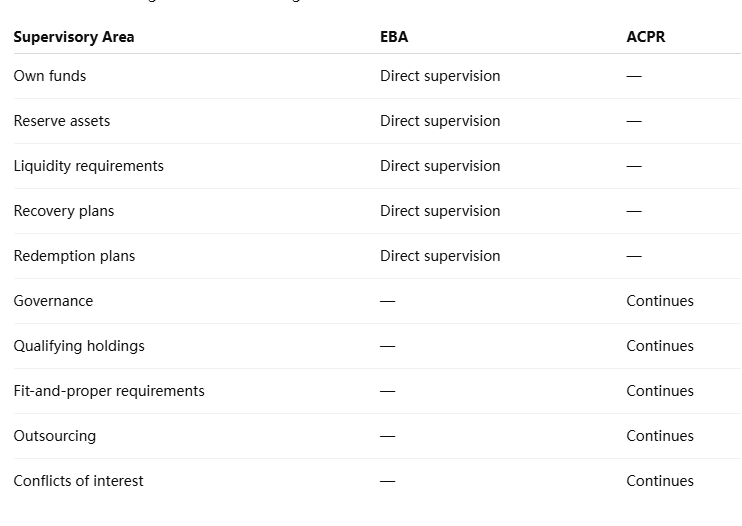
This structure highlights a fundamental difference between stablecoin market price and stablecoin financial resilience. A token can trade close to $1 during normal conditions because arbitrage and exchange liquidity keep the market aligned with par. The harder test comes when many holders want cash simultaneously. At that point, reserve quality, asset liquidity, banking access and redemption operations become more important than the secondary-market price visible on an exchange.
For a large stablecoin, redemption is therefore not simply a customer-service function. It is part of the financial architecture supporting the token's credibility. That helps explain why reserve liquidity and redemption planning sit at the center of enhanced EBA supervision.
Why Has USDC Become a More Important Regulatory Case?
The EBA's decision is significant partly because USDC is globally fungible. Circle's European issuer operates inside MiCA, but USDC also circulates through global exchanges, wallets, institutional platforms and blockchain applications outside the EEA. This gives the token unusually broad utility, but it also means European regulation cannot treat it as an isolated domestic e-money product.
Circle's MiCA documentation describes a structure under which eligible holders have redemption rights while reserves support the tokens in circulation. As USDC becomes more embedded in payments and financial applications, regulators need confidence not only that reserves exist but that those reserves can be converted into cash quickly enough during periods of concentrated redemption demand.
This produces a regulatory challenge that becomes more complex as adoption rises. A globally fungible token can move across jurisdictions within seconds, while the legal entities, bank accounts and reserve obligations supporting it remain jurisdiction-specific. The more broadly USDC is used, the more important regulatory coordination becomes.
That is why USDC MiCA status should be interpreted as evidence of stablecoin maturity rather than simply regulatory burden. Once a token is treated as meaningful financial infrastructure, regulators begin asking questions that resemble those applied to other systemically relevant financial instruments: how liquid are its backing assets, who bears responsibility during stress, and how quickly can holders recover cash?
Does Significant EMT Status Help USDC Adoption?
Potentially, but the effect is not one-directional. Enhanced EBA oversight can make USDC easier for banks, payment companies and corporate treasury teams to evaluate because responsibility for major prudential risks is clearer. Institutional users typically want to know who supervises reserves, what redemption protections exist and how an issuer is expected to respond to stress. A more explicit supervisory framework can reduce uncertainty around those questions.
At the same time, stronger supervision increases the cost of operating at scale. Capital, liquidity, reporting and contingency-planning requirements can become more demanding, and regulators may intervene more aggressively if they believe a stablecoin creates risks for financial stability or payment systems. The regulatory advantage of maturity is therefore accompanied by a regulatory cost.
This makes the designation neither automatically bullish nor punitive. USDC has gained regulatory significance because adoption creates both utility and responsibility. The same scale that can attract institutional integration also makes the token more important to supervise.
How Is a Significant EMT Different From an Ordinary EMT?
The underlying legal category does not change. USDC remains an e-money token; the difference lies in the supervisory layer applied to it.
An ordinary EMT must still comply with MiCA and relevant national rules. A significant EMT faces additional EBA involvement in prudential areas because the potential consequences of failure are greater. This creates a regulatory model in which successful stablecoins effectively face escalating obligations as they become more widely used.
That dynamic matters beyond USDC. If other EMTs reach the applicable significance criteria, they can move into a similar supervisory regime. MiCA therefore does not treat stablecoin regulation as static. It contains a mechanism through which regulatory intensity can increase alongside market importance.
For issuers, this means scale has two effects. It can improve liquidity, distribution and institutional relevance, but it can also increase capital requirements, reporting obligations and scrutiny. Stablecoin competition in Europe may consequently depend not only on adoption but on the issuer's ability to operate under increasingly demanding financial standards.
MEXC View: Stablecoin Scale Is Becoming a Regulatory Category
The most important lesson from USDC MiCA status is that stablecoin regulation is entering a second stage. Early rules focused on whether issuers were authorized, whether reserves existed and whether users had redemption rights. As stablecoins become embedded in payments, treasury and tokenized markets, regulators increasingly need to consider what happens when those instruments become financially important at scale.
The emerging progression is straightforward: authorization → adoption → scale → enhanced supervision.
This changes the competitive landscape. A stablecoin can no longer be evaluated only through market capitalization, exchange liquidity or blockchain integration. Institutional users will increasingly care about reserve composition, redemption performance, supervisory structure and the issuer's ability to withstand stressed liquidity conditions.
For USDC, the next useful measures are therefore not only circulation and transaction volume. How reliably redemption works, how liquid reserves remain and how Circle coordinates obligations across jurisdictions may become equally important indicators of whether a globally fungible stablecoin can function as durable financial infrastructure.
Risks and Limitations
The significant-EMT designation should not be treated as a government guarantee. The most important limitations remain:
- Significant does not mean risk-free. USDC retains issuer, reserve, banking, operational and blockchain risks.
- Enhanced supervision is not deposit insurance. USDC remains legally and economically different from an insured bank deposit.
- MiCA is an EU framework. USDC also operates through entities and infrastructures outside Europe.
- Redemption rights depend on functioning infrastructure. Banking disruptions and reserve-liquidity constraints can still matter.
- Regulation can evolve. EBA supervision and MiCA implementation can change as the market develops.
- Higher compliance standards can raise operating costs. Stronger resilience requirements are not free for issuers.
The cross-border structure also remains a long-term challenge. Global fungibility is one of USDC's strengths, but regulators need confidence that liabilities and reserves remain properly managed across different legal entities and jurisdictions. The balance between global interoperability and local regulatory accountability will remain central to stablecoin supervision.
USDC MiCA Status Shows Stablecoins Are Becoming Financial Infrastructure
USDC's classification as the EU's first significant e-money token matters because it demonstrates how stablecoin regulation changes once adoption becomes large enough to matter beyond the crypto market. USDC was already compliant with MiCA through Circle's European entity; the October decision does not create that legal status. It adds a higher supervisory layer focused on the financial risks most relevant to a widely used digital currency.
From November 12, the EBA will directly oversee areas such as reserves, liquidity, own funds, and recovery and redemption planning, while France's ACPR retains responsibility for governance and other issuer-level controls. The resulting structure reflects a stablecoin that has moved from simple authorization toward system-level supervision.
That transition could become increasingly important as stablecoins enter corporate payments, treasury systems and tokenized capital markets. The more financial activity depends on a digital dollar, the more regulators need to know whether its backing and redemption mechanisms can function under stress.
The longer-term meaning of USDC MiCA status is therefore not that Europe has declared USDC safe. It is that European regulation now has a practical framework for scaling supervisory intensity with stablecoin importance. If stablecoins continue becoming part of everyday financial infrastructure, regulatory significance may increasingly become a consequence of commercial success itself.
Sources
European Banking Authority — USDC classified as the first significant EMT in the EU:
https://www.eba.europa.eu/publications-and-media/press-releases/eba-classifies-usdc-first-significant-e-money-token-european-union
Circle — USDC MiCA White Paper:
https://www.circle.com/legal/mica-usdc-whitepaper
Circle — First Global Stablecoin Issuer to Comply with MiCA:
https://investor.circle.com/news/news-details/2024/Circle-is-First-Global-Stablecoin-Issuer-to-Comply-with-MiCA-EUs-Landmark-Crypto-Law/default.aspx
Risk Disclaimer: This article is for reference only and does not constitute investment advice. The cryptocurrency market is highly volatile. Please make decisions cautiously based on your individual circumstances.
You May Also Like
Netflix’s 6% Workforce Cut Puts Cost Discipline in Focus
Why ETFs Tracking the Same Index Can Deliver Different Returns