

SpaceX IPO Filing Reveals Bitcoin Holdings as SPCX Listing Plan Advances
SpaceX IPO Filing Reveals Bitcoin Holdings as SPCX Listing Plan Advances
SpaceX returned to public-market attention after Space Exploration Technologies Corp. filed a Form S-1 registration statement with the U.S. Securities and Exchange Commission on May 20, 2026. The filing marks a formal step toward a potential initial public offering and gives traders a clearer look at how SpaceX may enter the public equity market.
The filing says SpaceX is offering shares of Class A common stock and has applied to list them on Nasdaq and Nasdaq Texas under the symbol “SPCX.” It also states that no public market currently exists for SpaceX Class A common stock. That distinction matters: SpaceX has filed for an IPO, but SpaceX stock is not publicly trading yet.
SpaceX S-1 Filing Confirms Proposed SPCX Listing on Nasdaq
The S-1 confirms that SpaceX is pursuing an initial public offering of Class A common stock. The proposed public ticker is “SPCX,” and the company has applied for listing on Nasdaq and Nasdaq Texas. However, the filing remains preliminary. It includes blank placeholders for the number of shares, expected IPO price range, final delivery date, and other offering details. This means the filing confirms IPO intent and proposed ticker information, but not the final offering size, valuation, or IPO price. For market watchers, the key point is simple: SpaceX has moved from private-market speculation into a formal IPO filing process, but the public stock has not started trading.
SpaceX Stock Is Not Publicly Trading Yet Despite IPO Filing
The phrase “SpaceX stock” can be misleading at this stage. The S-1 filing confirms that SpaceX intends to list Class A common stock under the ticker SPCX, but it also states that no public market currently exists for that stock. That means investors should separate the IPO process from actual public trading. “SpaceX IPO” refers to the company’s proposed listing process. “SPCX” refers to the proposed stock ticker in the filing. “SpaceX stock” would refer to the future public equity only if the IPO is completed and shares begin trading. Until then, SpaceX remains a pre-IPO company. Any pre-IPO market exposure should not be confused with direct ownership of SpaceX public shares.
SpaceX Bitcoin Holdings Add a Treasury Exposure Layer
The filing also disclosed SpaceX’s Bitcoin position. The company reported holding 18,712 units of Bitcoin as of March 31, 2026 and December 31, 2025, with a cost basis of $661 million. The fair value of those Bitcoin holdings was $1.293 billion as of March 31, 2026 and $1.637 billion as of December 31, 2025. The filing also states that the fair value of these digital assets is determined using Level I inputs, meaning quoted prices in active markets.
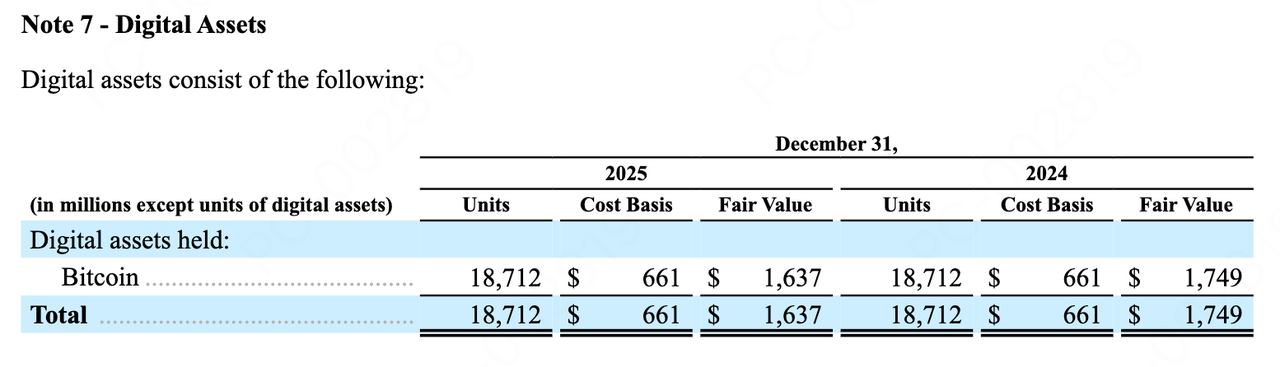
This disclosure adds a crypto-treasury layer to the SpaceX IPO story. The company is not only a private-market space and infrastructure name moving toward a public listing; it also has a material Bitcoin position on its balance sheet.
Bitcoin Has Stayed Broadly Stable Since the Filing
SpaceX’s Bitcoin disclosure is important, but it should not be read as a direct Bitcoin price signal. The filing shows that SpaceX holds Bitcoin and reports its fair value. It does not say SpaceX is buying more Bitcoin, selling Bitcoin, or forecasting Bitcoin’s price direction. Market data so far also supports a cautious reading. BTC traded around $77,536 on May 20 and around $77,648 on May 22, a small move of roughly 0.1% over the period. That suggests the disclosure has added narrative relevance more than an immediate repricing signal for Bitcoin. The better read is cross-asset. SpaceX’s IPO filing links a major private-company listing story with corporate Bitcoin treasury exposure. That may attract attention from both equity-market participants and crypto traders, but it does not by itself validate any short-term BTC price view.
Starship Test Activity Adds Visibility but Not a Direct Valuation Signal
SpaceX is also drawing fresh public attention from its latest Starship test activity. SpaceX’s official launch page says Starship’s twelfth flight test is preparing to launch, with a 90-minute launch window opening at 5:30 p.m. CT. The official live webcast is also available online. This matters mainly as a visibility catalyst. Starship-related updates can lift public attention around SpaceX, especially while the company is already in focus because of its IPO filing. But launch activity should not be treated as a direct signal for IPO pricing, SpaceX valuation, or Bitcoin direction. For traders, the cleaner interpretation is that multiple attention drivers are now overlapping: the S-1 filing, the proposed SPCX listing, the Bitcoin disclosure, and the latest Starship test cycle. These can all increase market attention around SpaceX, but each has a different information value.
SpaceX IPO Price Remains Unconfirmed in the Preliminary Filing
The S-1 filing does not yet provide a final SpaceX IPO price. The preliminary prospectus includes placeholders for the expected price range and share count, which means any current discussion of SpaceX IPO price remains provisional. Future amendments to the S-1, the final prospectus, or underwriter updates will matter more for confirmed pricing details. Traders should watch for the official IPO price range, offering size, final prospectus, listing date, and lockup terms, because those details will shape how the market values SpaceX once the IPO process moves further. For now, the filing gives investors a verified IPO reference point, but not a final valuation.
Key Risks Center on IPO Timing, Valuation Gaps and Pre-IPO Exposure
The SpaceX filing creates a clearer public-market reference point, but several risks remain. First, filing an S-1 does not guarantee immediate listing or fixed timing. The registration statement still needs to move through the SEC review process, and the company may update its filing before any final offering. Second, the final IPO price and offering size remain unconfirmed in the preliminary filing. Pre-IPO valuation expectations may differ from the final public-market price once shares begin trading. Third, SpaceX’s Bitcoin holdings add an important balance-sheet detail, but they do not remove valuation uncertainty. Bitcoin price changes may affect how some traders interpret SpaceX’s treasury exposure, but the disclosure does not prove future BTC direction. Finally, pre-IPO-related products or synthetic exposure should not be treated as the same thing as owning SpaceX stock. The main risk is misunderstanding the product structure.
Follow SPCXUSDT Perpetual Futures on MEXC


You May Also Like

Metaplanet buys 5,075 Bitcoin in Q1 to become 3rd-largest treasury

Critical USDT0 Response to Drift Hack Exposes Stark Contrast in Stablecoin Security Protocols

Iran’s foreign minister targeted in assassination attempt, wife killed



