Overview
Global enterprise computing and infrastructure provider
Hewlett Packard Enterprise (NYSE: HPE) delivered an expansive financial performance for its fiscal third quarter of 2026, posting net revenue of $12.21 billion, up 33.7% year over year. Catalyzed by enterprise generative artificial intelligence adoption and structural networking synergies unlocked through the integration of
Juniper Networks, the company achieved a historic milestone as non-GAAP diluted net earnings per share surged 152% to $1.11, marking the first time in corporate history that quarterly adjusted EPS crossed the $1 threshold. Despite beating consensus expectations across all core operating metrics and raising full-year financial projections, HPE common shares declined by more than 5% during extended trading on the
New York Stock Exchange. Market sentiment decoupled from headline profitability as executive leadership warned that severe shortages of critical server components, specifically High Bandwidth Memory, DDR5 DRAM, and advanced NAND flash, are capping the velocity at which a record-breaking $7.6 billion AI backlog can convert into recognized top-line revenue.
Key Takeaways
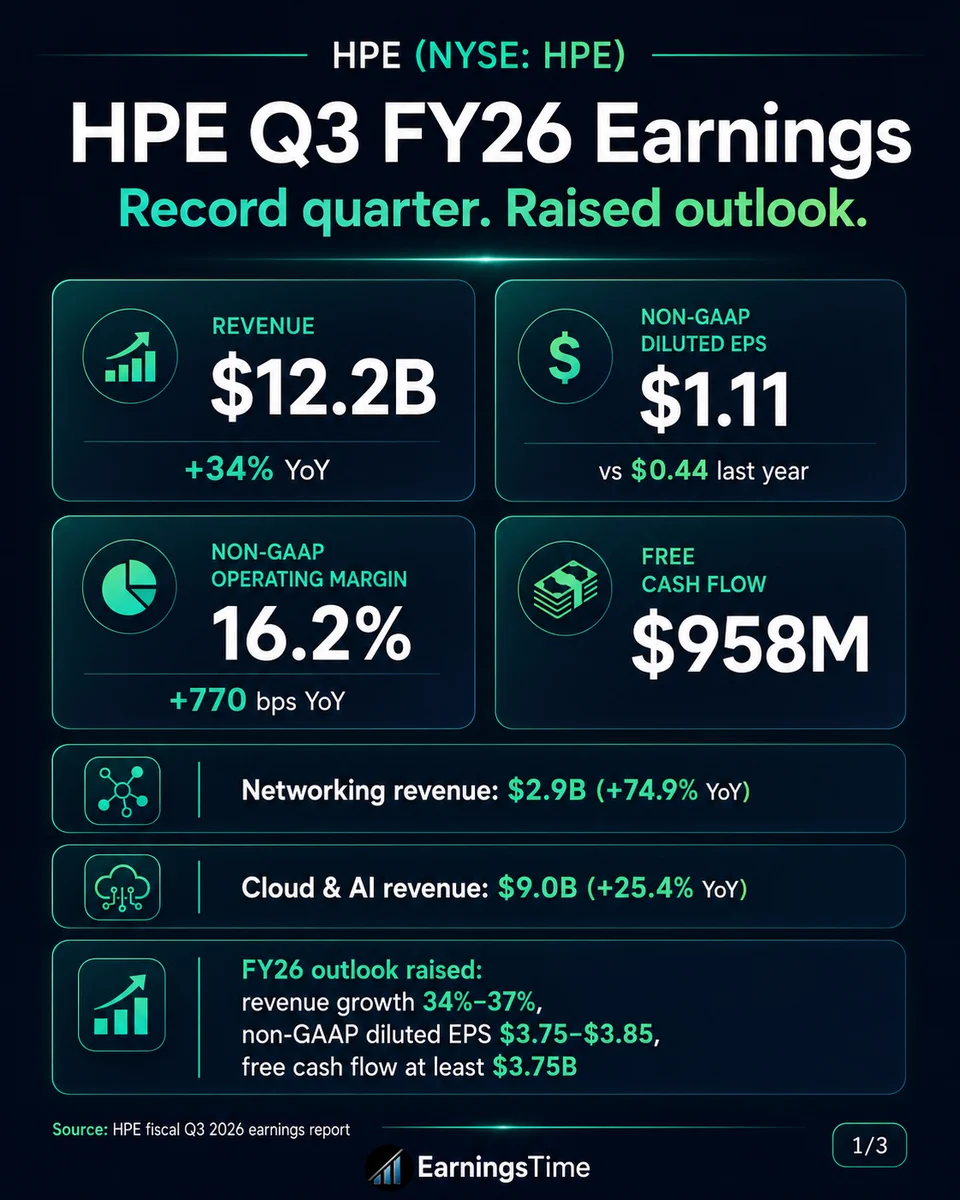
Record revenue and earnings expansion defined the quarter, as net revenue reached $12.21 billion and non-GAAP earnings per share surged to $1.11, beating consensus expectations of $11.89 billion and $0.93 respectively, supported by non-GAAP operating margins expanding 770 basis points to 16.2%.
Critical component shortages cap hardware fulfillment velocity, with corporate leadership highlighting that demand outstrips supply across High Bandwidth Memory, enterprise DRAM, and storage drives, widening the gap between 42% order growth and 34% revenue conversion.
Networking revenue exploded by 74.9% year over year, driven by the consolidation of Juniper Networks alongside organic demand for AI data center fabrics, with data center routing expanding by 270%.
Fiscal guidance raised across operational horizons, with management lifting full-year 2026 revenue growth targets to 34% to 37% and raising adjusted EPS expectations to $3.75 to $3.85, backed by an anticipated minimum free cash flow generation of $3.75 billion.
Cross-asset implications spotlight hardware supply chain inflation, illustrating that enterprise computing deployments have transitioned from GPU silicon constraints to complex bill-of-materials bottlenecks across memory fabrication and thermal assembly.
Secondary equity trading surrounding HPE common stock highlighted a stark divergence between backward-looking financial metrics and forward-looking supply chain pricing.
Record Revenue of $12.2 Billion and Historic Profitability Milestones
Regulatory disclosures registered with the
U.S. Securities and Exchange Commission confirm that HPE generated $12.21 billion in consolidated net revenue for the period ended July 31, 2026. The print surpassed the high end of internal management guidance and cleared the Bloomberg analyst consensus estimate of $11.89 billion. Operating performance reflected strong operational leverage, as non-GAAP gross margin reached a record 40% and non-GAAP operating profit expanded sequentially by roughly 40% to reach $2.0 billion. The achievement of $1.11 in quarterly adjusted EPS represents an increase of 152% over the prior-year period, validating the company's margin-accretive shift toward AI-optimized compute, specialized software, and hybrid cloud architectures.
Why Shares Dropped Over 5% Despite Historic Guidance Upgrades
The immediate post-earnings reaction saw shares drop as much as 8% before consolidating near a 5.5% loss in after-hours trading. Financial reporting from
Reuters indicates that institutional investors were positioned defensively following a multi-quarter rally that saw HPE equity more than double year to date. Elevated valuation multiples left little room for operational friction. When executive commentary highlighted that component availability would dictate revenue realization rather than unbounded customer appetite, institutional momentum desks executed aggressive profit-taking, rotating capital away from high-multiple server hardware.
Order Backlog Hits Record $7.6 Billion as Component Bottlenecks Constrain Shipments
Underlying operational data reveals that HPE is navigating an extreme divergence between customer commercial commitments and component procurement lead times.
Order Growth Outpaces Revenue Conversion by 3.5 Times
Market data compiled by
Bloomberg highlights that normalized orders accelerated by 42% year over year during the third quarter, setting an all-time corporate record. The velocity of incoming customer commitments exceeded revenue growth by roughly 3.5 times. AI system orders totaled $2.4 billion, expanding more than 30% sequentially, while specialized AI networking gear added $700 million in quarterly bookings. Cumulative artificial intelligence backlog climbed to an unprecedented $7.6 billion, comprising $6.8 billion in physical AI computing systems and $800 million in networking infrastructure. This expanding backlog confirms robust commercial traction but underscores the widening lag in converting committed contracts into recognized GAAP billings.
High Bandwidth Memory and DDR5 Supply Constraints as Physical Boundaries
During the executive conference call, management explicitly identified advanced memory as the primary gating factor constraining shipment volumes, alongside NAND storage and specialized processors. The structural transition toward large-scale generative inferencing and enterprise autonomous agents requires massive physical DRAM allocations per compute rack. However, leading memory fabricators including
SK Hynix and
Micron Technology have prioritized forward high-bandwidth capacity for tier-one cloud hyperscalers. Consequently, enterprise system integrators face prolonged delivery cycles for high-density DDR5 memory modules and advanced flash arrays. While HPE has signed long-term supply agreements and doubled purchase commitments, the physical scarcity of advanced memory will suppress revenue recognition through the remainder of the fiscal year.
Active market participants navigating tech equity breakouts and managing volatility use specialized institutional venues to optimize execution.
Furthermore, order book metrics on
MEXC show expanding liquidity and cross-market participation across technology-linked digital assets during high-volume earnings cycles.
Portfolio Re-Anchoring and Networking Synergy: Juniper Acquisition Drives 75% Segment Surge
Beyond server rack manufacturing, HPE's strategic repositioning toward enterprise connectivity emerged as the primary structural margin driver of the quarterly release.
Accelerating Juniper Integration and Data Center Routing Expansion
The strategic acquisition of Juniper Networks is yielding operational cost and revenue synergies ahead of initial corporate projections. Segment disclosures show that Networking revenue surged by 74.9% year over year to $2.89 billion, generating a segment operating margin of 22%. On a normalized basis excluding the acquisition footprint, core networking still expanded by 10%. Within the segment, Data Center Networking revenue more than doubled, while advanced routing product lines surged by 270%, reflecting accelerated adoption of high-speed Ethernet fabrics for modern GPU cluster interconnections.
The Oracle Partnership and Multi-Gigawatt AI Cloud Deployments
Customer distribution metrics demonstrate that HPE is successfully penetrating premier enterprise and cloud infrastructure budgets. The company announced an expanded collaboration with
Oracle to provide critical infrastructure for one of the industry's largest gigawatt-scale AI cloud buildouts. Furthermore, management disclosed that 59% of cumulative AI orders originated from enterprise and sovereign customers rather than traditional hyperscale cloud providers. This structural customer diversification insulates HPE from single-client procurement volatility, providing higher pricing power across private cloud deployments.
Balance Sheet Mechanics: Record 40% Gross Margin Meets Working Capital Pressures
An inspection of corporate balance sheet disclosures reveals the capital-intensive nature of fulfilling enterprise AI orders in an inflationary supply chain.
Inventory Buildup and Cash Flow Dynamics Ahead of Enterprise Shipments
Analysis from the
Financial Times illustrates that while HPE generated $958 million in third-quarter free cash flow, operating inventory expanded noticeably. To insulate production lines from acute semiconductor shortages and prepare for large-scale enterprise deployments scheduled for the fourth quarter, the company committed substantial liquid capital toward securing buffer component inventory. This buildup of work-in-progress hardware expands cash conversion cycles, requiring the company to deploy working capital upfront to defend its delivery timelines.
Upward Guidance Revisions for Fiscal 2026 and 2027
Reflecting confidence in underlying contract durability, executive leadership raised full-year targets across key operating metrics. For the fourth fiscal quarter of 2026, HPE expects revenue between $13.9 billion and $14.8 billion, with non-GAAP diluted EPS projected between $1.20 and $1.30. For the full fiscal year 2026, revenue growth projections were elevated to a range of 34% to 37%, with adjusted EPS revised upward to $3.75 to $3.85 and free cash flow pegged at a minimum of $3.75 billion. Looking out to fiscal 2027, management projected consolidated revenue expansion of 13% to 17% and free cash flow exceeding $5.0 billion, resting on the assumption that memory fabricators will expand advanced node output in the first half of 2027.
Cross-Asset Implications and Enterprise AI Monetization Trajectories
The structural dynamics revealed in HPE's financial release provide essential context for broad technology markets and alternative compute architectures.
Shifting from Hyperscaler Concentration to Sovereign and Corporate Clusters
Enterprise demand patterns indicate that capital expenditure is decentralizing away from pure public cloud model training into corporate on-premises inference clusters. The Cloud and AI segment generated $9.0 billion in revenue, with server revenue up 35.3%. According to coverage from
CNBC, Fortune 500 corporations are prioritizing hybrid deployments to protect corporate intellectual property. However, component price inflation for memory and networking equipment elevates total cost of ownership, potentially forcing mid-market corporations to pace their localized hardware acquisitions.
Spillover Effects on Distributed Computing and Alternative Tech Infrastructure
As enterprise compute servers command substantial price premiums and experience extended delivery timelines, developers are evaluating decentralized physical infrastructure networks (DePIN). The economic friction of procuring centralized hardware clusters is accelerating interest in blockchain-coordinated compute markets, utilizing smart contracts to orchestrate distributed enterprise server capacity as an alternative to wait-listed physical hardware delivery.
Market participants evaluating the long-term stabilization of HPE equity should track several operational checkpoints:
Component match rates and fulfillment velocity in the fourth fiscal quarter, verifying whether the $7.6 billion order backlog converts into recognized GAAP revenue without further shipment deferrals.
Operating margin durability across the expanded Juniper networking portfolio, ensuring that enterprise switching solutions sustain operating margins above the 20% benchmark.
Memory foundry supply expansions, observing whether capital expenditure programs by major DRAM fabricators ease procurement premiums for enterprise system builders.
Exclusive View from James Mitchell
From a quantitative market structure and liquidity perspective, the post-earnings pullback in HPE equity represents an event-driven repricing of supply chain duration rather than fundamental demand erosion.
Many retail market participants focus exclusively on the headline 34% top-line expansion and 152% surge in adjusted earnings per share, overlooking the working capital implications of a $7.6 billion backlog. In enterprise technology cycles, record backlog demonstrates commercial relevance, but when order velocity outpaces revenue recognition by 3.5 times, corporate performance becomes entirely subordinated to upstream component delivery timelines. Analyzing options implied volatility skew and dealer positioning confirms that institutional desks utilized the earnings release to harvest volatility premiums and de-risk long positions against inventory carrying costs. From a structural perspective, the integration of Juniper Networks provides HPE with high-margin enterprise switching assets that defend gross margins near the historic 40% level. For active derivative traders and cross-asset allocators, the pullback clears speculative froth and re-anchors valuation around tangible cash flow generation. The critical forward indicator is not headline booking growth, but the rate of inventory turnover across fourth-quarter server shipments and the stability of segment operating margins during large-scale customer handoffs.
FAQ
What were the headline financial metrics in the HPE fiscal third quarter report?
HPE reported net revenue of $12.21 billion, up 33.7% year over year, beating consensus expectations of $11.89 billion. Non-GAAP diluted net earnings per share surged 152% to $1.11, clearing expectations of $0.93. Gross margin reached a record 40%, and non-GAAP operating margin expanded to 16.2%.
Why did HPE stock decline after reporting record earnings and raising guidance?
The stock slid by more than 5% in extended trading because executive leadership warned that severe shortages of critical server components, specifically memory, NAND flash, and processors, are restricting shipment velocity. The persistent supply constraints prevent the company from immediately fulfilling its record $7.6 billion AI backlog, triggering institutional profit-taking following a substantial year-to-date rally.
What specific component shortages are impacting HPE ability to fulfill orders?
Management identified memory as the primary operational bottleneck, including High Bandwidth Memory modules and high-density enterprise DDR5 DRAM. In addition, tight supply across NAND flash storage, enterprise solid-state drives, and specialized compute silicon has lengthened system assembly cycles.
The acquisition transformed HPE networking business, driving segment revenue up 74.9% to $2.89 billion with a 22% operating margin. Data center networking revenue more than doubled, providing high-margin enterprise switching solutions that complement HPE accelerated server deployments.
What is the current size of HPE artificial intelligence order backlog?
HPE concluded the third fiscal quarter with a record cumulative AI backlog of $7.6 billion, comprising $6.8 billion in physical AI compute systems and approximately $800 million in specialized networking infrastructure.
What forward operational metrics should investors monitor in upcoming quarters?
Investors should monitor the conversion rate of backlog into recognized revenue, inventory turnover and working capital metrics, gross margin stability around the 40% threshold, and delivery lead times across the broader semiconductor memory supply chain.
Disclaimer
The information, analysis, and views contained in this article are provided for general educational and informational purposes only and do not constitute financial advice, investment advice, legal advice, tax advice, or a recommendation to buy or sell any security, digital asset, or financial derivative. Equity securities and financial instruments are subject to high market volatility and capital risk. Past operational performance, financial results, and quantitative indicators do not guarantee future market returns. Investors must conduct independent due diligence and evaluate their personal financial situation, risk tolerance, and investment goals before executing any trade. The MEXC Crypto Pulse team assumes no liability for any direct or indirect financial losses resulting from the use of or reliance upon the information published herein.
About the Author
James Mitchell specializes in technical analysis, market trends, and trading strategies for both Bitcoin and altcoins. Based in London, he has over 10 years of experience in financial markets. Before joining MEXC Learn, James worked as a senior analyst at a leading European investment firm, where he developed expertise in risk management and quantitative trading. His transition to cryptocurrency markets began in 2017, and he has since become recognized for his data-driven approach. He holds a Master's degree in Financial Economics from the London School of Economics. His analytical approach combines traditional technical analysis with on-chain metrics to provide readers with actionable insights. Areas of expertise include technical analysis, market trends and cycles, trading strategies, Bitcoin and altcoin analysis, and risk management.
Research References