Overview
Global enterprise computing and infrastructure leader
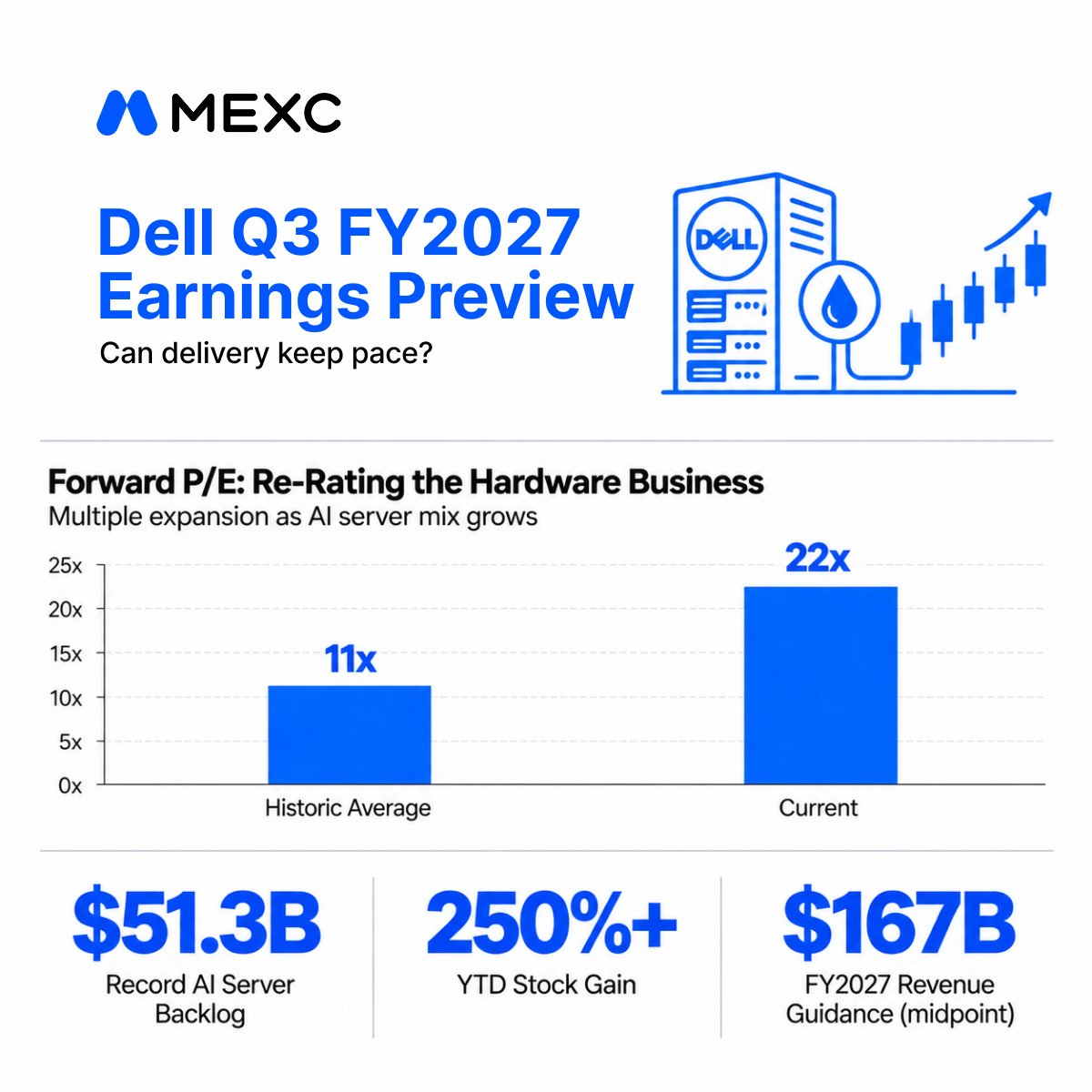
Dell Technologies (NYSE: DELL) is scheduled to release its fiscal quarterly earnings report, presenting a critical test of whether explosive generative artificial intelligence hardware demand can justify historic equity valuation multiples. Driven by accelerating enterprise adoption of high-density computing clusters and private on-premises foundation model deployments, Dell common stock has appreciated by more than 250% year to date, outperforming broader technology indices. According to consensus estimates compiled by
Bloomberg, Wall Street projects quarterly revenue of approximately $44.9 billion, representing year-over-year expansion of more than 50%, alongside diluted earnings per share (EPS) of $4.89. However, with the company's Infrastructure Solutions Group (ISG) backlog reaching a record $51.3 billion, market attention has shifted from verifying gross order volumes to scrutinizing conversion lead times, high-bandwidth memory supply bottlenecks, and whether lower initial margins on artificial intelligence server racks will dilute corporate operating profitability.

Key Takeaways
Historic backlog expansion secures multi-quarter visibility as Dell exited its previous reporting period with a record $51.3 billion AI server backlog, representing contracted order volume that significantly exceeds quarterly production capacity.
Demanding consensus benchmarks require exceptional execution, with Wall Street projecting $44.9 billion in quarterly revenue and a doubling of earnings per share to $4.89, placing heavy scrutiny on management's $167 billion full-year revenue outlook.
Physical supply chain bottlenecks dictate revenue realization velocity, as tight allocations across High Bandwidth Memory, advanced packaging nodes, and optical transceivers represent the primary binding constraint on rack deliveries.
Product mix shifts trigger margin and operating leverage dynamics, with lower gross margins on specialized accelerator racks offset by structural operating leverage that expanded infrastructure segment margins to 10.5%.
Client Solutions Group provides baseline cash flow stability, supported by enterprise commercial personal computer refresh cycles and premium average selling prices across next-generation artificial intelligence PC architectures.
Record Backlog and High Financial Expectations: How $51.3 Billion in Demand Reshapes Dell
Over recent fiscal periods, Dell Technologies has transitioned beyond traditional personal computing to establish itself as a primary engineering integrator of enterprise artificial intelligence clusters.
According to data center supply chain tracking published by
Reuters, Dell booked more than $24 billion in AI-optimized server orders during its preceding operating quarter, recognizing $16.1 billion in AI server revenue for an annual growth rate exceeding 750%. This surge propelled Infrastructure Solutions Group (ISG) revenue toward $29 billion. Exiting the period with an unprecedented $51.3 billion in AI order backlog prompted corporate management to elevate full-year AI server revenue expectations to roughly $60 billion.
Trading across the
New York Stock Exchange demonstrates that market participants are evaluating the velocity of physical delivery. Regulatory filings submitted to the
U.S. Securities and Exchange Commission show that management guided full-year fiscal 2027 revenue to $167 billion at the midpoint, with diluted GAAP earnings per share projected near $17.31. To maintain momentum, the company must exceed consensus targets while demonstrating that weekly rack-scale shipments can scale without logistical friction.
Multiple Expansion and the Margin Debate: Does Hardware Scale Dilute Profitability
Dell's equity advance has expanded its forward price-to-earnings multiple from historic cyclical averages near 11x to roughly 22x, prompting institutional analysts to evaluate the underlying margin composition across business segments.
Balancing Single-Unit Gross Margins with Operating Leverage
Because artificial intelligence servers incorporate expensive third-party processing accelerators, single-unit gross margins typically fall in the mid-single digits, below traditional enterprise storage and software solutions. Analysis published by the
Financial Times illustrates that while high-volume server deliveries can mathematically dilute corporate gross margin percentages, the massive top-line expansion creates substantial operating leverage. Fixed research, general, and administrative expenses are absorbed over a wider revenue base, allowing infrastructure operating margins to expand to 10.5% despite hardware input costs.
High-Margin Enterprise Storage and Liquid Cooling Cross-Selling
To maximize revenue capture per deployed megawatt, Dell utilizes structured cross-selling programs. By pairing its flagship PowerEdge XE9680 and liquid-cooled XE9680L server racks with proprietary PowerStore and PowerScale all-flash storage arrays, the company attaches high-margin data management software to raw compute deployments. As enterprise customers structure unstructured corporate datasets for model fine-tuning, storage revenues are projected to expand roughly 10% year over year, providing a margin buffer for the consolidated business.
Physical Supply Chain Constraints: High Bandwidth Memory and Advanced Packaging Bottlenecks
The primary variable governing whether Dell can deliver upside financial surprises remains physical component availability from upstream semiconductor manufacturers.
Advanced Semiconductor Allocation Pressures
Dell's flagship computing systems integrate advanced processor architectures from
Nvidia alongside instinct accelerators from
AMD. Industry supply chain checks confirm that delivery timelines are governed by foundry packaging capacity, High Bandwidth Memory die allocations, and optical interconnect production schedules. Lead-time extensions in any sub-component prevent completed rack clusters from undergoing final burn-in validation, deferring revenue recognition across reporting periods.
Specialized Neocloud and Sovereign AI Order Prioritization
Dell's customer pipeline comprises Fortune 500 enterprises alongside specialized cloud infrastructure providers like
CoreWeave and international sovereign computing initiatives. Large-scale infrastructure clients require strict shipment delivery windows. Managing allocation parity between multi-gigawatt cloud providers and high-margin corporate enterprises serves as a primary test of Dell's global manufacturing and logistics orchestration.
To manage market volatility and hedge technology equity risk during major corporate earnings releases, market participants utilize specialized derivative instruments.
Order book metrics on
MEXC demonstrate sustained depth and cross-market turnover across equities-linked digital assets during major technology earnings windows.
Core Enterprise Cash Flow: Client Solutions Group and Commercial PC Dynamics
While data center server demand drives multiple expansion, Dell's Client Solutions Group (CSG) provides foundational cash flow generation.
Commercial PC Enterprise Replacement Lifecycles
Enterprise reporting from
CNBC indicates that corporate personal computer demand is entering an upgrade cycle, supported by operating system lifecycle transitions and the natural depreciation of hardware deployed during previous procurement windows. Dell's direct sales distribution model across commercial enterprise accounts has protected average selling prices, compensating for broader consumer hardware moderation.
Edge Hardware Contributions to Corporate Cash Flow
The introduction of commercial personal computers equipped with dedicated neural processing units (NPUs) has supported operating profitability across client hardware lines. Although personal computer revenue growth remains moderate compared to server clusters, the division generates billions in recurring operational cash flow, funding corporate debt retirement, share repurchases, and working capital requirements for large-scale server manufacturing inventories.
Downside Risks and Forward Guidance Checkpoints
While record backlogs provide strong forward visibility, market participants should evaluate several critical operational and financial variables:
Revisions to full-year corporate guidance, observing whether executive management increases the $167 billion revenue midpoint or expands the $60 billion AI server revenue expectation.
Infrastructure segment operating profit margin resilience, monitoring whether ISG margins sustain levels above 10% as accelerator hardware constitutes an expanding percentage of overall deliveries.
Executive commentary regarding upstream semiconductor lead times, evaluating updates on component availability across next-generation graphics processors and memory dies.
Operating cash flow conversion rates, assessing whether elevated working capital allocations for raw component procurement impact the company's commitment to return more than 80% of adjusted free cash flow to shareholders.
Exclusive View from James Mitchell
From a quantitative market structure and capital cycle perspective, Dell's share price advance heading into earnings represents a fundamental repricing of physical systems engineering within the global artificial intelligence value chain.
Traditional valuation models historically categorized Dell as a low-margin hardware assembler, pricing the equity at low cyclical multiples while underestimating the severe engineering barriers required to deploy multi-megawatt liquid-cooled compute racks. Integrating thousands of accelerated chips with high-density power delivery, direct-to-chip liquid cooling manifolds, and non-blocking network fabrics represents specialized physical infrastructure engineering. A $51.3 billion backlog confirms that Dell functions as an essential prime contractor for physical compute deployments globally. Options implied volatility metrics indicate elevated expectations ahead of the earnings release. For professional traders and cross-asset allocators, meeting baseline consensus figures is already priced into the equity, meaning the primary catalyst for continued multiple expansion resides in management's ability to raise full-year hardware guidance above $60 billion while demonstrating that high-margin storage attachments can protect operating profitability. As long as operating cash flow conversion remains resilient, Dell's transition toward enterprise technology compounder status remains intact.
FAQ
Why has Dell stock gained more than 250 percent this year?
Dell stock surged due to explosive revenue growth in its AI-optimized server division. Server revenues climbed over 750% in the previous quarter, pushing total AI backlog to a record $51.3 billion and leading management to raise full-year AI server revenue expectations to roughly $60 billion.
What are Wall Street consensus expectations for Dell earnings?
Consensus estimates project quarterly revenue of approximately $44.9 billion, representing more than 50% year-over-year top-line growth, with earnings per share expected to reach $4.89, driven primarily by strong server and storage shipments within the Infrastructure Solutions Group.
What is the significance of the $51.3 billion AI server backlog?
The $51.3 billion backlog demonstrates that customer compute demand significantly outpaces current manufacturing supply, providing Dell with multi-quarter revenue visibility and confirming that high infrastructure investment extends beyond near-term deliveries.
Why do some analysts express concern regarding AI server gross margins?
AI servers incorporate expensive third-party processor accelerators, resulting in gross margins in the mid-single digits, which are lower than traditional enterprise storage and software products. Rapid growth in server revenue can create the mathematical appearance of gross margin compression even as operating profit dollars expand.
What is Dell direct liquid cooling engineering advantage?
As processor power consumption exceeds one thousand watts per socket, traditional air cooling reaches physical thermodynamic limits. Dell's direct-to-chip liquid cooling solutions deliver fluid directly across compute silicon, reducing data center power consumption while maximizing compute density within standard rack footprints.
How do component supply chain shortages impact Dell financial results?
Tight supply across High Bandwidth Memory, advanced packaging capacity, and optical transceivers can extend assembly timelines. Delays in receiving critical components prevent completed racks from achieving final customer sign-off, slowing the conversion of backlog into recognized revenue.
What is the current operational status of the Client Solutions Group?
The Client Solutions Group is experiencing stable performance supported by enterprise commercial PC replacement demand and higher average selling prices for AI PCs, generating consistent operating cash flows that support broader corporate operations.
Disclaimer
The information, analysis, and views contained in this article are provided for general educational and informational purposes only and do not constitute financial advice, investment advice, legal advice, tax advice, or a recommendation to buy or sell any security, digital asset, or financial derivative. Equity securities and financial instruments are subject to high market volatility and capital risk. Past operational performance, financial results, and quantitative indicators do not guarantee future market returns. Investors must conduct independent due diligence and evaluate their personal financial situation, risk tolerance, and investment goals before executing any trade. The MEXC Crypto Pulse team assumes no liability for any direct or indirect financial losses resulting from the use of or reliance upon the information published herein.
About the Author
James Mitchell specializes in technical analysis, market trends, and trading strategies for both Bitcoin and altcoins. Based in London, he has over 10 years of experience in financial markets. Before joining MEXC Learn, James worked as a senior analyst at a leading European investment firm, where he developed expertise in risk management and quantitative trading. His transition to cryptocurrency markets began in 2017, and he has since become recognized for his data-driven approach. He holds a Master's degree in Financial Economics from the London School of Economics. His analytical approach combines traditional technical analysis with on-chain metrics to provide readers with actionable insights. Areas of expertise include technical analysis, market trends and cycles, trading strategies, Bitcoin and altcoin analysis, and risk management.
Research References