Felix Pago Raises $200M: Are Stablecoins Fixing Remittances?
Overview
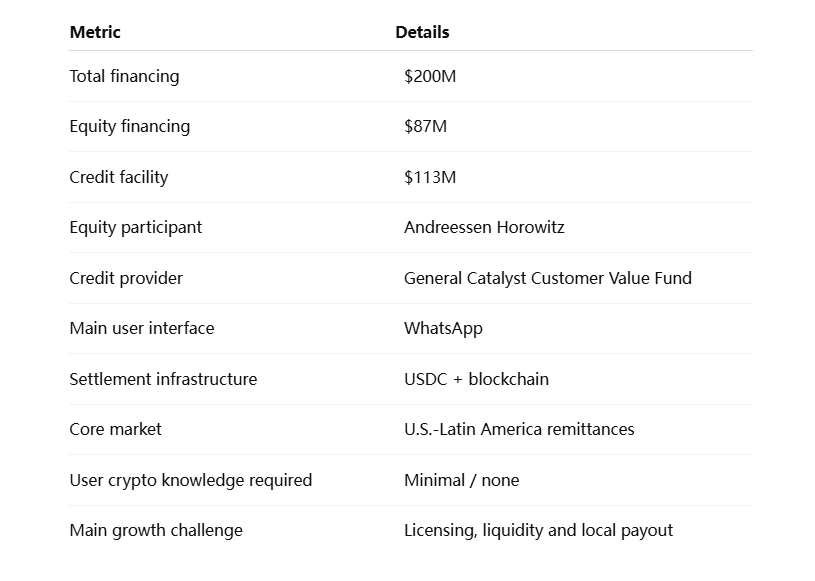
Felix Pago has secured a $200 million financing package as it expands a stablecoin-enabled remittance network focused on Latin America. The financing includes $87 million in equity funding and a $113 million credit facility, combining growth capital with additional balance-sheet capacity for a business built around cross-border money movement.
The Felix Pago stablecoin remittance model is notable because users do not need to interact directly with crypto. The service uses WhatsApp as the consumer-facing interface, while USDC and blockchain infrastructure operate in the background to move value between markets. A sender can initiate a remittance through a familiar messaging app, while stablecoins help support the settlement process behind the scenes.
That model illustrates an important shift in stablecoin adoption. The largest long-term use cases may not require consumers to understand wallets, private keys or even which blockchain is being used. Stablecoins can instead become invisible financial infrastructure connecting fiat collection, cross-border settlement and local payout.
The $200 million financing gives Felix Pago additional resources to expand that model, but scale will depend on licensing, local payout networks, fraud controls and whether the company can consistently deliver lower-cost and faster remittances than established providers.
Key Takeaways
- Felix Pago secured $200 million across equity and credit financing.
- The package includes $87 million in equity and a $113 million credit facility.
- Felix Pago uses WhatsApp as its primary user interface.
- USDC and blockchain infrastructure support settlement behind the scenes.
- Users do not necessarily need to hold or understand stablecoins directly.
- The bigger thesis is that stablecoin adoption may become invisible to end users.
How Did Felix Pago Secure $200M?
Why Separate Equity From Credit?
The $200 million figure should not be treated as a single equity round.
Felix Pago raised $87 million in equity financing, with Andreessen Horowitz among the participants, while General Catalyst's Customer Value Fund provided a $113 million credit facility.
The distinction matters because equity and debt support different parts of a financial business.
Equity can fund hiring, product development, licensing and geographic expansion. A credit facility can provide additional working capital and liquidity to support remittance flows as transaction volumes increase.
For a cross-border payments company, access to funding liquidity can be especially important because money often needs to be prefunded across markets before end-user settlement is complete.
What Could the Financing Support?
Felix Pago can use the new capital to expand into additional remittance corridors, strengthen compliance infrastructure and improve its consumer product.
The company is particularly focused on flows between the United States and Latin America, including major corridors such as U.S.-to-Mexico transfers.
Remittance businesses need local banking, payout and regulatory relationships in each market. Expansion is therefore operationally intensive even when the underlying settlement layer uses blockchain.
The funding can also support fraud prevention and customer verification, both of which become increasingly important as transaction volume scales.
Felix Pago Financing Snapshot
How Does Felix Pago Use Stablecoins?
Does the User Need to Hold USDC?
Not necessarily.
This is one of the most important features of the Felix Pago stablecoin remittance model. A consumer can interact through WhatsApp and send money without manually buying USDC, managing a blockchain wallet or handling private keys.
The crypto infrastructure operates behind the application layer.
From the user's perspective, the product can look like a messaging-based remittance service. Behind the scenes, stablecoins can help move dollar value between financial partners and geographic markets more efficiently.
This approach lowers one of the biggest barriers to mainstream crypto adoption: requiring users to understand the technology before receiving the benefit.
Why Use USDC Behind the Scenes?
Stablecoins can move continuously across blockchain networks and do not depend on traditional correspondent banking hours.
That can reduce the need to wait for several banks to sequentially process cross-border transfers.
USDC also provides a dollar-denominated settlement asset, which can help Felix move value between jurisdictions before converting funds into the local currency required for final payout.
However, stablecoins do not eliminate every cost. Fiat collection, foreign exchange, compliance and local payout still require financial infrastructure.
The advantage is primarily in the settlement layer between those endpoints.
Why Is WhatsApp Important for Latin American Remittances?
Familiar Interfaces Can Matter More Than Blockchain Technology
WhatsApp is already deeply embedded in everyday communication across Latin America.
Using a messaging platform as the front end can reduce customer acquisition friction because users do not need to download an unfamiliar financial application or learn a new interface.
A customer can begin a transaction through the same environment they use to communicate with family and businesses.
This is strategically important because remittance customers generally care more about cost, trust and delivery speed than the underlying technology.
A stablecoin settlement system may therefore be most successful when it becomes invisible.
Can Conversational Payments Expand Access?
Potentially.
Messaging-based interfaces can simplify the remittance process for users who are less comfortable navigating complex financial applications.
An AI-assisted conversational flow can guide the user through recipient details, amount selection and transaction status.
This could improve accessibility, but it also raises additional fraud and verification requirements.
Payments conducted through messaging platforms must still comply with identity, sanctions and anti-money-laundering rules.
The easier the user experience becomes, the more robust the underlying compliance controls need to be.
Can Stablecoins Lower Remittance Costs?
Where Can Blockchain Reduce Friction?
Traditional cross-border transfers can involve correspondent banks, prefunded accounts and several intermediaries between sender and recipient.
Each intermediary can add cost and settlement time.
A stablecoin can potentially move dollar value between financial partners more directly and continuously.
This may reduce the amount of capital that needs to remain idle in multiple correspondent accounts and allow settlement operations to continue outside banking hours.
For high-volume remittance corridors, even small improvements in liquidity efficiency can matter.
What Costs Still Remain?
Stablecoin settlement does not make remittances free.
A provider still needs to collect fiat from the sender, perform KYC and compliance checks, convert between currencies and deliver funds to the recipient.
Local payout partners may charge fees, while foreign exchange spreads can remain significant.
Blockchain networks and stablecoin issuers also create their own operational dependencies.
The proper question is therefore whether stablecoins reduce total end-to-end cost compared with the alternative, not whether blockchain transactions themselves are cheap.
Felix Pago vs Traditional Remittances
StageTraditional RemittanceFelix-Style Stablecoin ModelUser interfaceApp, branch or websiteWhatsAppSettlement layerCorrespondent bankingStablecoin-enabledOperating hoursOften constrainedPotentially 24/7User crypto knowledgeNoneNone requiredFiat collectionRequiredRequiredFX conversionRequiredRequiredLocal payout partnersRequiredRequiredStablecoin visible to userNoUsually no
Why Is Latin America a Strong Stablecoin Use Case?
Dollar Demand and Cross-Border Payments Overlap
Many Latin American economies have strong demand for dollar-linked assets because of inflation, currency volatility or cross-border trade.
At the same time, the region receives substantial remittance flows from workers abroad.
Stablecoins naturally sit between those two needs because they provide a digital representation of dollar value that can move across borders.
The user does not necessarily need to hold the stablecoin long term. It can function primarily as the settlement bridge between two fiat endpoints.
This makes remittances one of the clearest real-world use cases for stablecoin infrastructure.
Why Mexico Matters
The U.S.-Mexico corridor is one of the world's largest remittance markets.
Large transaction volumes create strong incentives to reduce cost and settlement delays.
Even a modest improvement in operating efficiency can become meaningful when applied across millions of transfers.
For Felix Pago, success in major corridors can also create infrastructure and compliance experience that can later be extended into additional Latin American markets.
MEXC View: Stablecoin Adoption May Become Invisible
The strongest stablecoin adoption may eventually come from users who never knowingly interact with a stablecoin.
Crypto markets often measure adoption through wallet counts, token holdings or exchange volume. Payments infrastructure can develop differently. A consumer may use WhatsApp, pay in dollars and receive pesos while a stablecoin handles the settlement in the background.
That means future stablecoin competition could become less about convincing users to "buy stablecoins" and more about which payment companies can integrate digital dollars most efficiently into existing consumer behavior.
For the crypto industry, this is an important shift. Stablecoins can become infrastructure rather than products that users consciously choose.
The key metrics to watch are remittance volume, cost per transfer, transaction speed, repeat users and how much settlement capital Felix can move through stablecoin rails without increasing compliance or fraud losses.
What Could Slow Felix Pago's Growth?
Regulation and Licensing
Remittance providers operate under financial regulations in both sending and receiving markets.
Each new country can require additional licensing, compliance procedures and relationships with local banks or payment institutions.
Stablecoins do not remove those requirements.
In some cases, they may introduce additional scrutiny around blockchain transactions and stablecoin counterparties.
Felix therefore needs to expand its regulatory infrastructure at the same pace as its consumer product.
Fraud and Identity Risk
Fast digital transfers are attractive to legitimate users but also to fraudsters.
Messaging-based payments can be targeted by account takeovers, social engineering and identity fraud.
Felix must maintain strong transaction monitoring while preserving a simple customer experience.
This balance becomes harder as transaction volume and geographic coverage increase.
USDC and Counterparty Dependence
Using USDC creates exposure to the stablecoin's issuer, banking partners and redemption infrastructure.
The token has strong liquidity and institutional adoption, but it is still a privately issued digital dollar.
Felix must therefore manage stablecoin counterparty risk alongside ordinary banking and payout-partner risk.
A resilient remittance platform should be able to maintain service even if one settlement route becomes temporarily unavailable.
Felix Pago Shows Stablecoins Can Win Without Looking Like Crypto
Felix Pago's $200 million financing package is notable because it supports a model in which stablecoin technology is largely invisible to the user.
Consumers interact through WhatsApp rather than a crypto wallet. They send conventional money and expect recipients to receive local currency. USDC operates behind the scenes as part of the settlement infrastructure.
This model represents a more mature form of blockchain adoption. Users do not need to understand the technology in order to benefit from faster or more efficient cross-border movement.
The financing also shows that building a stablecoin remittance network requires more than software. Felix needs equity capital to expand its product and regulatory footprint, while the $113 million credit facility provides additional balance-sheet capacity for a business that moves money continuously across borders.
The next test is execution. Felix must prove that stablecoin settlement produces durable cost and speed advantages while maintaining strong compliance, fraud prevention and local payout reliability.
If it succeeds, the Felix Pago stablecoin remittance model could demonstrate something important about mainstream crypto adoption: the winning infrastructure may be the technology users never notice.
Sources
https://www.generalcatalyst.com/
https://jobs.generalcatalyst.com/companies/felix-2-5bbe8bb6-3263-4a82-af9b-85191483f0b9
Risk Disclaimer: This article is for reference only and does not constitute investment advice. The cryptocurrency market is highly volatile. Please make decisions cautiously based on your individual circumstances.


Можда ће вам се такође свидјети

Singapore Stablecoin Regulation: What Could MAS Change?
Gold Price Falls Toward $4,300 as Rate-Hike Expectations Return
Robinhood Memecoin: What It Means and Why the Sector Is Growing