

MiCA Architect Urges EU to Prioritize Tokenization Over DeFi Rules
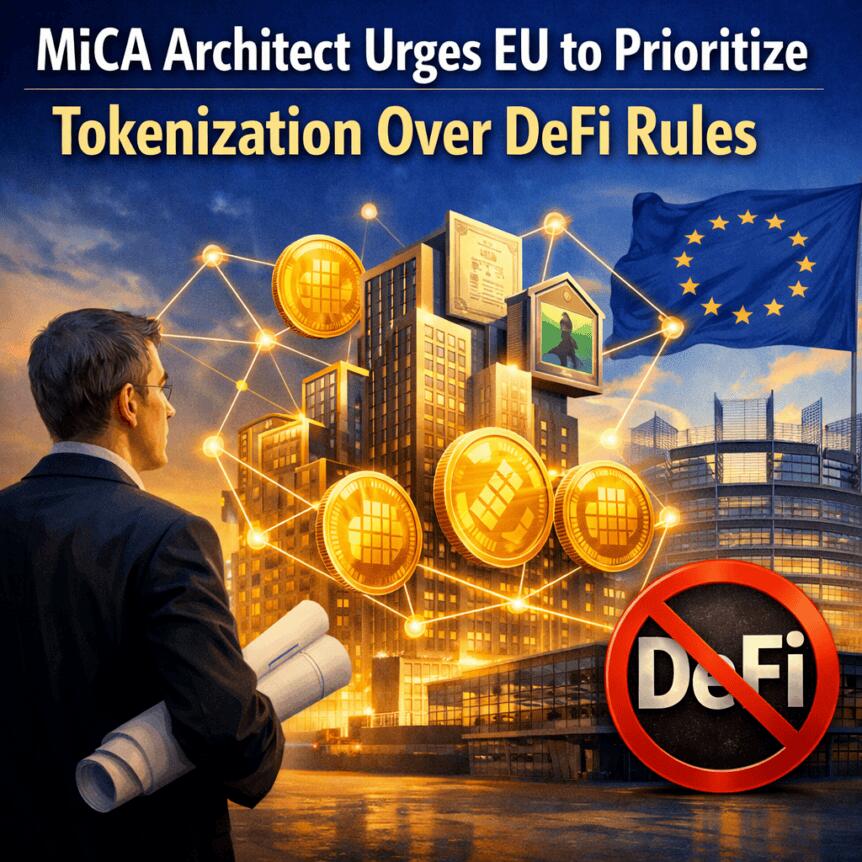
The European Union’s approach to crypto regulation is shifting toward a broader digital asset framework, with calls to include real-world assets and tokenization rather than directing regulatory energy solely at decentralized finance (DeFi) through a second MiCA reboot. The European Commission’s MiCA review is in motion, having launched a public consultation in May and inviting feedback through Aug. 31.
“I do not believe that [MiCA] is outdated now. That’s my personal opinion, but it does not matter. That’s why we have this consultation,” said Peter Kerstens, a MiCA architect at the European Commission, during a fireside chat at WAIB Summit Monaco 2026. He emphasized that the input gathered during the consultation will help shape the bloc’s next regulatory steps.
As a reminder, MiCA is undergoing its review ahead of a potential second iteration. The public consultation comes as the bloc grapples with a shifting landscape for crypto firms and products. Separately, MiCA is approaching a critical deadline: the end of its transitional period on July 1, after which crypto asset service providers must hold a MiCA license to serve EU clients or halt operations there.
Key takeaways
- EU’s MiCA reform is reframing focus toward a broad digital asset framework, including real-world assets and tokenization, not just DeFi.
- The Commission’s public consultation on MiCA runs through Aug. 31, shaping the next regulatory steps while MiCA’s transitional period ends on July 1.
- DeFi is acknowledged as a risk area in the consultation, but one MiCA architect argues that regulating decentralized networks presents fundamental challenges because laws target entities, not networks.
- New research from the European Central Bank questions whether some governance models are truly decentralized, potentially impacting how DAOs fit within MiCA’s scope.
A broader regulatory horizon beyond DeFi
Kerstens framed the MiCA review as an opportunity to recalibrate the EU’s approach to digital assets, moving beyond a narrow DeFi focus. The Commission has signaled that the consultation will help determine whether MiCA should be complemented—or even supplanted—by a wider framework capable of addressing tokenization of real-world assets and other innovations in the asset class. The current consultation documents outline a range of “emerging risk areas,” including DeFi, but they do not obligate a redesign of MiCA in its current form. The overarching aim, Krstens suggested, is to maintain clear, pan-EU rules that cover the diverse realities of crypto markets while avoiding unnecessary fragmentation across member states.
The debate underscores a broader regulatory objective: ensuring investor protection, market integrity, and financial stability as the EU digital asset ecosystem evolves. While MiCA was designed to provide a comprehensive framework for crypto assets, the evolving landscape—with tokenized securities, real-world assets, and cross-border use cases—presents a case for a more expansive regime that can harmonize novel tokens with existing financial infrastructure.
DeFi scrutiny without a fixed MiCA target
Despite including DeFi as an area of potential risk in the current consultation, Kerstens argued that regulating DeFi bodies would be difficult under existing legal doctrines. Laws are generally crafted to regulate people and organizations, not the technical architectures that enable networks to operate. He described DeFi as a “movement” lacking centralized representation, which complicates the creation of traditional regulatory levers aimed at “entities.”
The tension here reflects a broader regulatory challenge: how to address operational and systemic risks associated with decentralized protocols that do not neatly fit into a framework designed for centralized service providers. While DeFi’s risk profile—ranging from capital efficiency to governance and transparency—remains on regulators’ radar, the path to regulation may require novel legal concepts that can address networks as opposed to conventional intermediaries.
DAOs under the regulatory microscope
Meanwhile, the ECB has explored the question of whether governance models used by some decentralized autonomous organizations (DAOs) can truly be considered decentralized enough to fall outside MiCA. A March working paper highlighted that in prominent protocols, governance tokens are highly concentrated: in top projects such as Aave, MakerDAO, Ampleforth, and Uniswap, the top 100 holders controlled more than 80% of the governance token supply in snapshots from late 2022 and mid-2023. The authors argued these dynamics raise questions about the degree of decentralization and whether such structures should be treated as “fully decentralized” services outside MiCA’s scope.
These findings contribute to a broader debate about which organizational forms deserve lighter regulatory treatment and which should be encompassed by comprehensive asset regulation. The ECB’s analysis does not settle the issue, but it adds a data-driven perspective to the discussion about how to categorize DAOs under EU rules.
For readers tracking regulatory progress, the ECB’s examination complements the Commission’s MiCA review by highlighting practical realities in token governance and the potential misalignment between governance architecture and regulatory expectations. The ongoing consultation will reflect those tensions as policymakers weigh how to integrate DAOs and other decentralized structures into a coherent EU framework.
What comes next for EU crypto regulation?
With July 1 looming for MiCA’s transitional period and Aug. 31 set as the consultation deadline, the EU faces a pivotal moment in harmonizing its approach to crypto markets. The dialogue between regulators and industry participants will shape whether MiCA evolves into a more expansive framework or remains a specialized regime with targeted updates. The central question remains: can the EU craft rules that protect consumers and investors while accommodating rapid innovation in tokenization and real-world asset integration?
Readers should watch for the Commission’s subsequent policy steps after the consultation closes, including potential legislative proposals and alignment with cross-border financial rules. As the EU navigates the balance between protection and innovation, the outcome will likely influence how other jurisdictions approach DeFi, DAOs, and tokenized assets in the years ahead.
The European Commission’s MiCA review and related ECB insights together outline a regulatory arc that could redefine Europe’s crypto rulebook—one that weighs broad asset-tokenization playbooks against the practical realities of decentralized technology.
This article was originally published as MiCA Architect Urges EU to Prioritize Tokenization Over DeFi Rules on Crypto Breaking News – your trusted source for crypto news, Bitcoin news, and blockchain updates.


You May Also Like
Former Republican congressman warns Trump turning GOP into 'party of sore losers'

Exclusive interview with Smokey The Bera, co-founder of Berachain: How the innovative PoL public chain solves the liquidity problem and may be launched in a few months

Iran’s army chief warns of ‘total destruction’ for ground invasion



